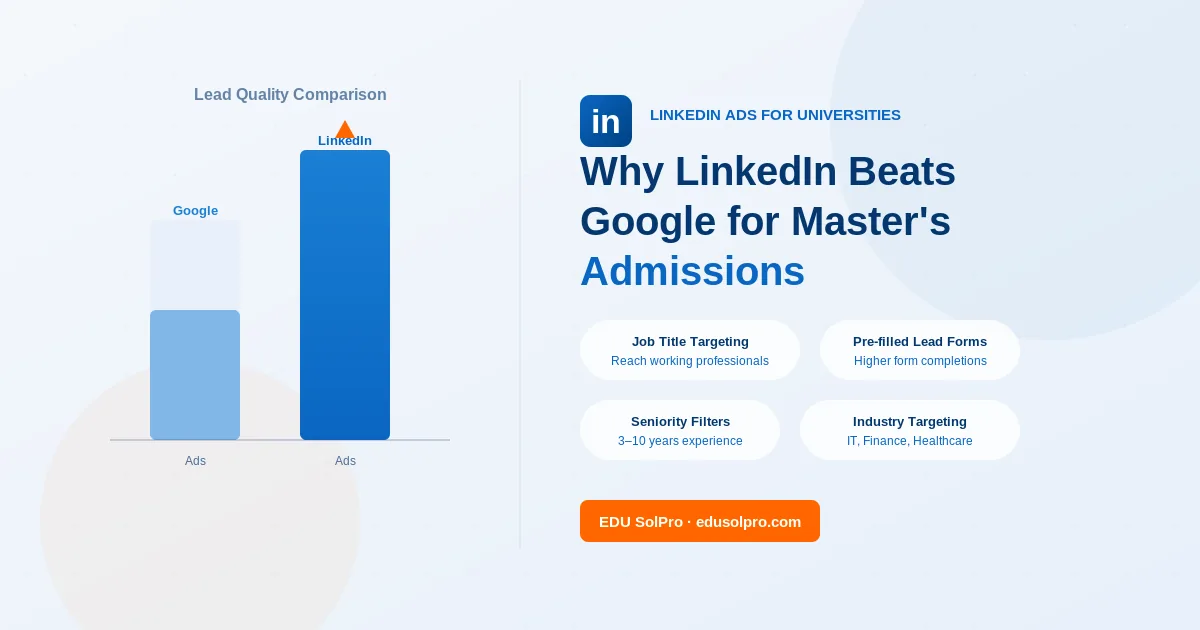
A university running Google Ads for its MBA programme gets roughly 400 clicks a month. Of those, about 12 fill the inquiry form. Of those 12, the counsellor team qualifies 3 as genuinely interested. The other 9 are students who clicked without reading the ad properly, or curious browsers, or people who somehow ended up on a university page while searching for something adjacent.
The same university runs LinkedIn Ads targeting working professionals in Gujarat with 3 to 8 years of experience in IT and finance. They get 60 clicks a month. Fourteen fill the form. Eleven are counsellor-qualified leads.
Fewer total clicks. More useful conversations. The reason comes down to one difference: who was on the platform when the ad appeared.
The Audience Problem That Google Ads Cannot Solve
Google Ads matches ads to search queries. If someone searches “MBA colleges in Ahmedabad,” Google shows them a relevant ad. The system works well for this — but it has a structural limitation for PG admissions that most university marketing teams don’t fully account for.
Google cannot tell you, at the moment of matching, whether the person typing that search is a 17-year-old who just finished a BCom, a 28-year-old IT professional wondering if an MBA would accelerate their career, or a 45-year-old browsing out of general curiosity. All three see the same ad. All three might click. Only one of them is a real Master’s programme prospect.
LinkedIn knows the difference, because the platform is built on professional identity. Every LinkedIn user has a job title, an industry, an employer, a years-of-experience range, and an educational background — and they’ve entered this information themselves, because it’s the point of being on LinkedIn.
When a university targets LinkedIn users with 4 to 9 years of experience in banking or technology, it is reaching people who match the actual profile of a working professional weighing a PG programme. The irrelevant audience (recent graduates, students, the simply curious) is filtered out before the ad runs, not after.
What LinkedIn targeting actually looks like for PG admissions
LinkedIn Campaign Manager gives universities a set of targeting parameters that have no equivalent in Google Ads.
Job title and job function let a university reach people whose current role matches the target applicant profile. An MBA programme with a finance specialisation can target people in financial planning, investment analysis, or banking. An MCA programme can target software developers and QA engineers who want to move into leadership roles.
Seniority is one of the more useful filters for PG admissions. The options run from Entry Level through Associate, Mid-Senior Level, Manager, and Director. For most Master’s programmes, Entry Level through Mid-Senior Level is the right range — people early enough in their career that a further qualification makes sense, but past the stage where they’re still weighing whether to do a job at all.
Years of experience works alongside seniority. For a 1 or 2-year Master’s, targeting professionals with 3 to 8 years in the workforce tends to produce the most relevant audience. These are people who have seen enough of their industry to understand what a postgraduate degree would actually do for their trajectory, but haven’t yet plateaued into a role where the credential feels beside the point.
Industry filters by the sector where the user is currently employed. This lets a university separate IT professionals at mid-sized companies (who might want an MBA in operations or tech management) from healthcare professionals (who might be considering hospital administration or healthcare management). Without this filter, both groups see the same generic ad.
Company size is underused. A university offering an executive-track MBA can filter for companies with 200 to 1,000 employees, the range where mid-level professionals are established enough to get employer budget approval for sponsored education, but aren’t in a global firm with an internal leadership pipeline that makes an external MBA less compelling.
None of these parameters exist in Google Ads. Meta has rough equivalents built on behavioural inference, but they’re far less reliable because users don’t keep their Meta profiles current the way they maintain LinkedIn.
The Lead Gen Form Advantage
LinkedIn’s Lead Gen Forms are a feature that changes the conversion economics of PG admissions campaigns significantly.
In a standard digital advertising setup, a user clicks an ad, lands on a university website, navigates to an inquiry form, and fills it out manually. Each of those steps is a dropout point, and form completion rates fall sharply with each additional click and each field the user has to fill manually.
LinkedIn Lead Gen Forms work differently. When a user clicks on a Lead Gen Form ad on LinkedIn, the form opens directly within the app — pre-populated with their LinkedIn profile data. Name, email address, phone number, job title, current company, and location all populate automatically. The user reviews the pre-filled information, taps submit, and the lead is sent to the university’s CRM.
The friction drops substantially. Users don’t navigate to a new page, don’t type anything manually, and don’t have to look up information they’ve already entered on their LinkedIn profile. On mobile, where most LinkedIn usage in India happens, this typically means the difference between a 3% form completion rate and something closer to 15%.
For a university running PG admissions campaigns, Lead Gen Forms also produce higher-quality contact data. Phone numbers and email addresses pulled from LinkedIn profiles are typically current and accurate, unlike form submissions where users sometimes enter incorrect or placeholder contact details to reduce counsellor follow-up.
Where Google Ads still wins — and why both have a place
This is not an argument for abandoning Google Ads. Google Ads solves a different part of the admissions problem.
Google Ads captures intent. A professional who has already decided they want to do an MBA and is actively searching “best MBA colleges in Pune distance learning” is a warm lead: they’ve defined their intent through the search query itself. Google puts a university in front of that person at exactly the right moment.
LinkedIn Ads creates intent. A professional who has not yet articulated a desire for further education but who matches the ideal applicant profile sees a compelling message about what an MBA could do for their career. LinkedIn introduces the idea before the search even happens.
Both channels belong in a full PG admissions funnel. The universities getting the best results run Google Ads to capture active searchers and LinkedIn Ads to reach latent demand — the professionals who would apply if the right programme found them, but who haven’t started searching yet.
The cost structure: CPL vs lead quality
One objection to LinkedIn Ads that comes up consistently is cost per lead. LinkedIn Ads do tend to produce a higher CPL (cost per lead) than Google Ads or Meta Ads in raw rupee terms.
This comparison is misleading without adjusting for lead quality.
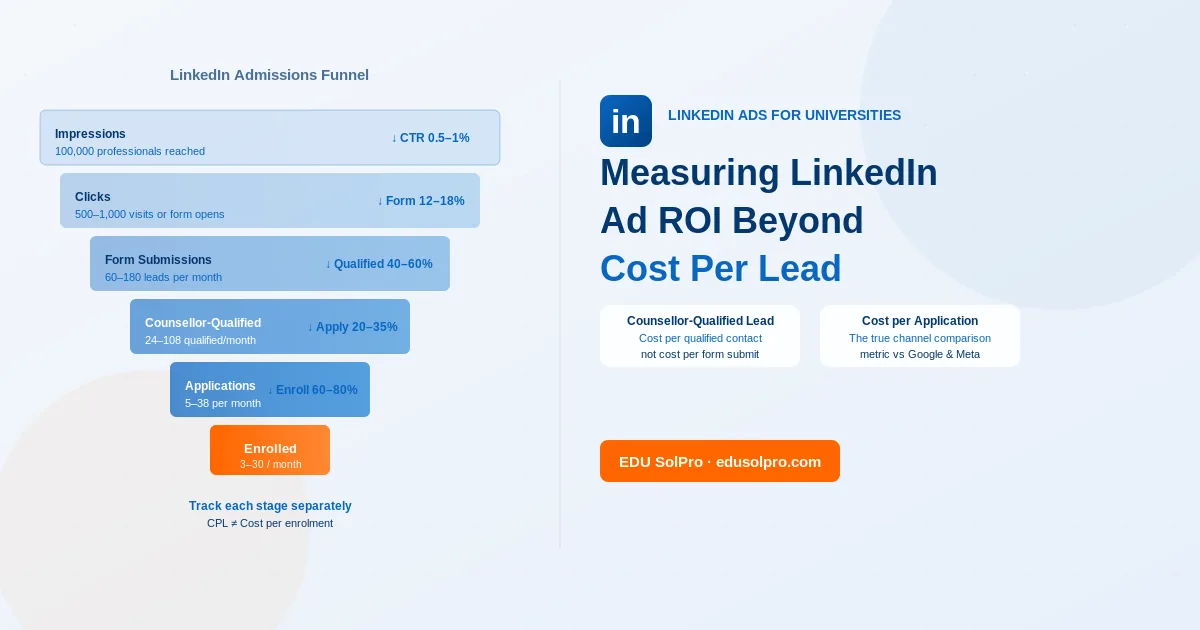
If a university pays ₹300 per lead on Google Ads and 8% of those leads result in an application, the effective cost per application is ₹3,750. If the same university pays ₹900 per lead on LinkedIn but 28% result in an application (because the audience is pre-qualified by professional profile and intent), the cost per application is ₹3,214. LinkedIn is cheaper at the stage that matters.
The universities that dismiss LinkedIn Ads based on CPL alone are comparing the wrong number. CPL is a useful metric for benchmarking ad efficiency within a channel. It is a poor metric for comparing channels that reach fundamentally different audiences.
The correct comparison is cost per counsellor-qualified lead and cost per application. When those are tracked accurately, LinkedIn typically outperforms Google on PG admissions campaigns — not because the clicks are cheaper, but because a higher proportion of people who click are actually the right audience.
Programme types where LinkedIn outperforms
Not every university programme is the right fit for LinkedIn Ads. The channel works best where the target applicant is a defined professional rather than a student in general.
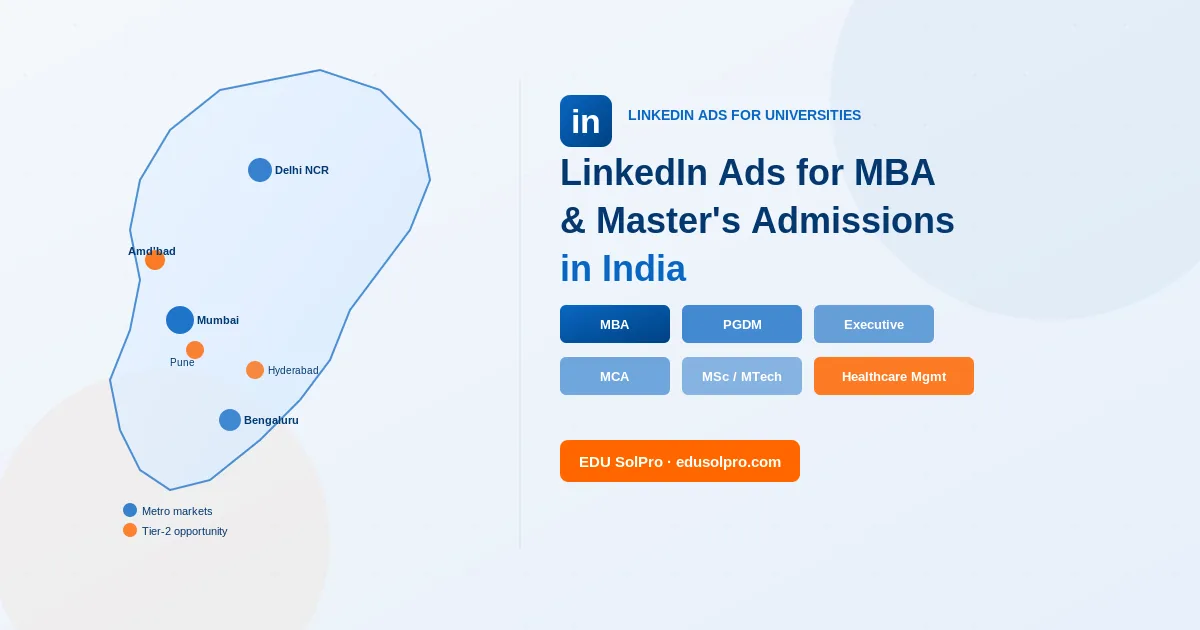
MBA and Executive MBA programmes are the clearest fit. The target applicant is working, has 3 to 10 years of experience, and is at a career inflection point. LinkedIn’s targeting parameters map precisely to this profile.
Master’s programmes with industry-specific applicant profiles also perform well: MCom and CFA-prep-linked programmes targeting finance professionals, MCA programmes targeting IT professionals looking to move into senior technical or product roles, and MBA in Healthcare Management targeting clinical staff considering administration tracks.
Distance learning and executive programmes benefit particularly strongly because the applicant needs to be already employed — which LinkedIn’s professional audience guarantees by definition.
Where LinkedIn underperforms is in UG admissions targeting 17 to 19-year-olds, for the obvious reason that this demographic is simply not using LinkedIn as an active platform. For UG admissions, Google, Meta, and Snapchat each have meaningful roles, while LinkedIn does not.
Getting the creative right for LinkedIn
LinkedIn users are scrolling a professional feed. The ad creative and copy need to match that context.
Ads that work on Meta — bright visuals, student lifestyle imagery, emotional hooks about campus culture — tend to underperform on LinkedIn. The professional context demands professional framing. Content that speaks to career outcomes, salary trajectories, leadership readiness, and employer respect for the credential resonates with LinkedIn’s audience in ways that campus life imagery does not.
Sponsored Content (in-feed ads) should lead with the career outcome, not the programme name. “From Team Lead to VP in 3 Years: How an MBA Changed the Career Trajectory” outperforms “Apply for MBA 2026 Batch” because the first ad speaks to what the target audience is actually thinking about their professional life.
Message Ads (personalised messages delivered directly to LinkedIn inboxes) require a conversational tone and a clear, single call to action. They work best for warm retargeting (reaching people who’ve engaged with a previous sponsored content ad) rather than cold outreach, because the personalised format reads as presumptuous if sent to someone who has no prior contact with the institution.
For a real-world example of how this plays out, read the CEPT University LinkedIn Ads case study — a specialist Master’s campaign where professional audience targeting produced the clearest results across seven programmes simultaneously.
For detailed guidance on the targeting setup, the campaign structure, and how to organise LinkedIn Ads to align with different stages of the PG admissions funnel, read our guide on targeting working professionals for PG admissions on LinkedIn.
For an overview of how LinkedIn fits into the broader performance marketing mix for universities, our post on performance marketing for universities covers how different paid channels interact at each stage of the admissions funnel.
Our LinkedIn Ads service for universities covers campaign setup, audience building, creative development, and the CRM integration that makes lead follow-up immediate rather than delayed.
Frequently Asked Questions
What budget is realistic to start LinkedIn Ads for a university? A meaningful test campaign for one Master’s programme typically requires a minimum of ₹60,000 to ₹80,000 per month over at least 90 days. LinkedIn’s minimum daily spend thresholds and the relatively higher CPL compared to other channels mean smaller budgets produce too few leads to draw reliable conclusions. Universities with less budget available are better served by running Google Ads only until there’s capacity to test LinkedIn properly.
Can LinkedIn Ads work for programmes below Master’s level? For PG diploma programmes that target working professionals — PGDM, executive education, online certificate courses — yes. For full-time undergraduate programmes, LinkedIn is not the right channel. The target audience isn’t on LinkedIn in the numbers or with the engagement level needed for cost-effective PG admissions campaigns.
How long before LinkedIn Ads start producing qualified leads? The first 30 days of a LinkedIn campaign are typically a learning phase — the algorithm optimises delivery, and the university team learns which audience segments respond. Counsellor-qualified leads typically start appearing in meaningful numbers in weeks 5 to 8. Campaigns evaluated purely on month one results are almost always cancelled prematurely.
What CRM integrations does LinkedIn Lead Gen Forms support? LinkedIn Lead Gen Forms integrate natively with Salesforce, HubSpot, Marketo, and a number of other major CRMs via built-in connectors. For universities using custom or local CRM tools, leads can be exported automatically via Zapier or directly downloaded as CSV from LinkedIn Campaign Manager. Read more about LinkedIn Lead Gen Forms specifically for university admissions.
Should universities run LinkedIn Ads year-round or only during admission season? Intent-capture campaigns (targeting people actively searching) should concentrate on the 3 to 4 months before each admissions deadline. Awareness campaigns — which build familiarity with the institution among professionals who might consider applying in the next 6 to 18 months — can run at lower spend year-round. The most effective programmes run both simultaneously, adjusting the budget split seasonally.