The Indian PG admissions market has two clearly different channels for the same programme type.
Search ads (Google) reach professionals who have already decided they want a qualification and are actively looking. LinkedIn reaches those who might apply if the right programme appeared in front of them at the right moment — the much larger pool of working professionals who haven’t yet articulated the search query.
For MBA, PGDM, MCA, and specialist Master’s programmes, this second group is where the real volume opportunity sits. Most working professionals in India with 4 to 8 years of experience have thought about further education. Very few have typed “MBA colleges in Ahmedabad” into Google this month. LinkedIn Ads create the moment that starts that process.
Here’s how LinkedIn Ads work across the most common PG programme types in India, and what distinguishes the campaigns that fill seats from those that spend budget without results.
MBA and PGDM: the clearest LinkedIn use case
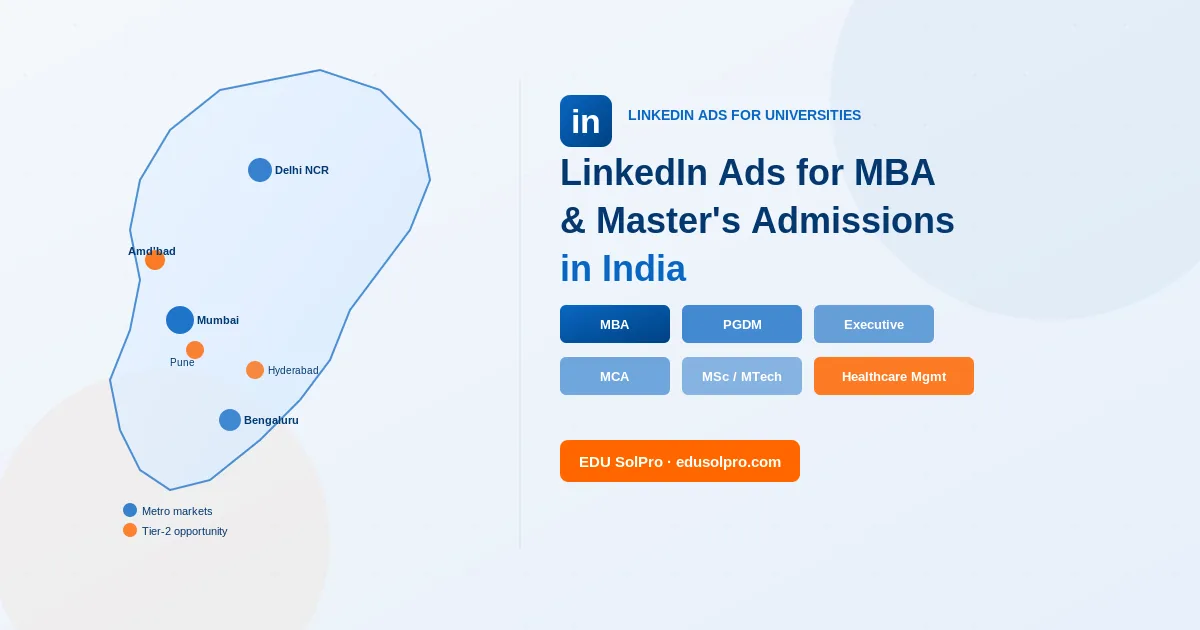
An MBA or PGDM programme from a private university in India typically targets working professionals with 2 to 7 years of experience who are looking to accelerate into management. This is the profile LinkedIn was designed around — employed, professionally active, identifiable by job function, industry, and seniority.
The targeting setup for a standard MBA campaign on LinkedIn would filter by:
- Seniority: Entry Level, Associate, Mid-Senior Level (covering the 2 to 7-year bracket)
- Industry: IT, Banking, Financial Services, Healthcare, Manufacturing, Retail (adjusting for the specific programme’s placement strengths)
- Geography: The university’s primary feeder states, with separate ad sets by region
- Experience: 2 to 7 years
The creative should not lead with rankings or accreditation. A working professional seeing a LinkedIn ad is thinking about their career, not about NAAC grades. The ad copy that performs is the kind that speaks to what the MBA would actually do for someone in their position: moving from individual contributor to manager, qualifying for roles at larger companies, developing the credential that formally recognises what they’ve been doing informally for five years.
The one caveat is programme duration. For a 2-year full-time campus-based MBA, the target professional needs to be willing to stop working and attend full-time, which narrows the audience to those who are earlier in their career (closer to 2 to 4 years of experience) and who haven’t yet built up enough financial or professional commitments to make a 2-year pause difficult. LinkedIn campaigns for full-time MBAs that don’t account for this often attract interest from professionals who can’t practically attend and produce leads that counsellors can’t convert.
For PGDM programmes, the audience setup is similar, but PGDM from an approved business school is a qualification type that some candidates specifically seek because of its industry reputation in India. Targeting can sometimes include professionals who list MBA interest directly on their LinkedIn profiles, or who follow management-focused company pages.
Executive MBA: where company size targeting matters most
Executive MBA programmes in India target a different applicant: someone with 8 to 15 years of experience, typically at Manager or Senior Manager level, who needs a formal qualification that fits around an established career rather than pausing it.
LinkedIn’s company size filter becomes more useful here than for standard MBA targeting. The most responsive audience for Executive MBA tends to be professionals at companies with 200 to 2,000 employees — large enough that there’s an HR function and potential employer sponsorship, but not so large that internal leadership tracks make the external qualification redundant.
Geography targeting for Executive MBA can often be city-specific rather than state-wide. These programmes tend to draw from a university’s immediate metro area because the weekend or evening format means travel distance matters. A business school in Pune running an Executive MBA on weekend format can target Pune, Mumbai, and Nashik as its primary geography with confidence, rather than spending budget across Maharashtra indiscriminately.
Message Ads (InMail) work particularly well for Executive MBA because the format allows a longer, more personalised pitch. A well-crafted Message Ad that speaks directly to the recipient’s professional stage — “You’ve spent a decade building expertise in your field. An EMBA gives it the formal language that opens the next level of doors” — can outperform Sponsored Content for high-value, considered-purchase programmes like Executive MBA.
MCA: targeting IT professionals at the right stage
An MCA programme sits in a different position from MBA — it’s a technical qualification that attracts IT professionals looking to move from implementation into senior technical or leadership roles, and increasingly, computer science graduates who want a structured postgraduate credential in computing.
For working professional MCA campaigns, the targeting narrows significantly:
- Industry: Information Technology and Services, Computer Software, Internet
- Seniority: Entry Level, Associate, sometimes Mid-Senior Level (depending on programme type)
- Job function: Information Technology, Engineering, Product Management
- Experience: 2 to 6 years for career-accelerating programmes; 3 to 8 years for part-time formats
The creative for MCA campaigns needs to address a specific tension: IT professionals considering an MCA often wonder whether the time and cost is worth it when their industry already values demonstrable skills over formal credentials. The ad copy and landing content need to directly address this — the specific career outcomes (team lead, product manager, solutions architect roles that explicitly list a Master’s in CS or equivalent), the salary differential for MCA holders at senior levels, and the employers who specifically require it.
Universities with strong IT sector placement records should name the companies, not just the percentages.
Specialist Master’s: finance, healthcare, and data
Several specialist Master’s programmes have particularly strong fit with LinkedIn’s professional targeting because the target applicant has a very specific professional profile.
MBA in Finance or MCom programmes targeting finance professionals can use LinkedIn’s industry and job function filters to reach people in banking, investment management, insurance, and accounting — the professionals most likely to see a finance Master’s as relevant to their next career move.
MBA in Healthcare Management or Hospital Administration reaches a meaningful audience on LinkedIn among clinical professionals (doctors, pharmacists, physiotherapists) considering a shift into hospital management, and among existing hospital administrators looking to formalise their operational expertise. This audience is identifiable on LinkedIn through healthcare industry targeting and healthcare-specific job functions.
MBA programmes with data analytics, business intelligence, or digital transformation specialisations have a natural LinkedIn audience among mid-career IT professionals whose companies are pushing through digital initiatives and who see the management + analytics combination as the credential for leading those projects rather than executing them.
The key for all specialist programmes is that the creative and landing content should speak to the specific professional context of the target audience. A generic MBA ad shown to a healthcare professional is wasted. The same budget spent on a healthcare management-specific creative that references their career context — “From clinical practice to hospital leadership” — is a different conversation.
Distance learning and online programmes: the national opportunity
Online and distance learning programmes have a different LinkedIn campaign structure from campus-based programmes, mainly because geography stops being a constraint.
For a well-regarded online MBA from a UGC Distance Education Bureau-approved institution, the relevant audience is India-wide: working professionals in any city who want the qualification without relocating or pausing their careers. A national campaign makes sense in a way it doesn’t for a full-time campus programme.
The challenge with online programme campaigns on LinkedIn is differentiation. The distance learning MBA market in India has become crowded, and LinkedIn users who match the target profile are seeing multiple similar ads. The campaigns that stand out either target a very specific industry segment (rather than all professionals generically) or lead with a specific outcome that the programme is particularly associated with (a placement record in a particular sector, a specific industry partnership, a particular alumni network benefit).
Online programme campaigns also benefit more from LinkedIn’s Retargeting and Matched Audiences features than campus programme campaigns. A professional who clicked on an ad for an online MBA but didn’t inquire can be retargeted 14 to 30 days later with a second ad — perhaps a student testimonial, or a placement data point — that catches them at a later point in their decision-making process.
What Indian universities get wrong on LinkedIn
Running LinkedIn Ads correctly takes different habits from Google or Meta. The same mistakes show up repeatedly in underperforming university campaigns.
Audience size is a common problem. LinkedIn’s algorithm needs enough people in the target audience to optimise delivery efficiently. Below 50,000, delivery gets unstable and CPL inflates. Universities that stack too many targeting filters end up with a highly precise but too-small audience that the platform can’t spend against reliably.
Creative is the other consistent problem. LinkedIn users are in work mode. An ad built around student campus photography and “Apply Now for 2026 Batch” belongs on Instagram. On LinkedIn, creative that speaks to career outcomes and specific industry relevance outperforms lifestyle-focused ads consistently — not slightly, substantially.
CRM integration matters more on LinkedIn than on other channels because Lead Gen Forms deliver leads in real time. If those leads sit in Campaign Manager for 48 hours before a counsellor sees them, the follow-up call is starting from a cold position. Universities without lead notification or CRM integration are losing conversion they already paid for.
Stopping campaigns too early is a pattern. LinkedIn optimisation takes longer than Google or Meta — the first 30 days are genuinely a learning phase. Universities that compare LinkedIn results to Google results at the 30-day mark and cancel the campaign have consistently underestimated what the channel produces by month 3.
Finally, running one campaign for all programmes. MBA, MCA, Executive MBA, and specialist programmes have different audiences, different concerns, and different reasons to apply. One campaign with one creative for all of them produces a message that is relevant to nobody in particular.
Campaign structure: how to organise a LinkedIn admissions account
A well-structured LinkedIn Ads account for a university running multiple PG programmes looks something like this:
Each programme gets its own campaign, with its own audience, its own creative, and its own Lead Gen Form. The MBA campaign is separate from the MCA campaign. The Executive MBA is separate from the standard MBA. This is not excessive complexity — it’s what allows the university to see which programme is producing which results and to allocate budget accordingly.
Within each campaign, running two to three ad variants simultaneously — different headlines, different images, different opening lines — lets LinkedIn’s delivery algorithm identify which creative resonates more with the target audience over the first 3 to 4 weeks. After that learning period, the lower-performing variants can be paused and budget consolidated onto what’s working.
For universities new to LinkedIn Ads, starting with one programme (the one with the clearest professional applicant profile) and one well-built campaign is more productive than launching across all programmes simultaneously with thin budgets and unoptimised targeting.
Budgets and timelines for Indian university LinkedIn campaigns
Realistic budget guidance for Indian university LinkedIn campaigns, based on what’s needed to generate meaningful data:
A single-programme LinkedIn campaign generating enough leads to evaluate properly typically requires ₹60,000 to ₹80,000 per month over at least 90 days. Less than this and the sample size of leads is too small to draw conclusions about audience quality, creative performance, or counsellor conversion rates.
For a university running two programmes simultaneously, ₹1.2 to 1.5 lakh per month covers both adequately at this stage. Scaling beyond this makes sense after the 90-day learning period has identified what’s working.
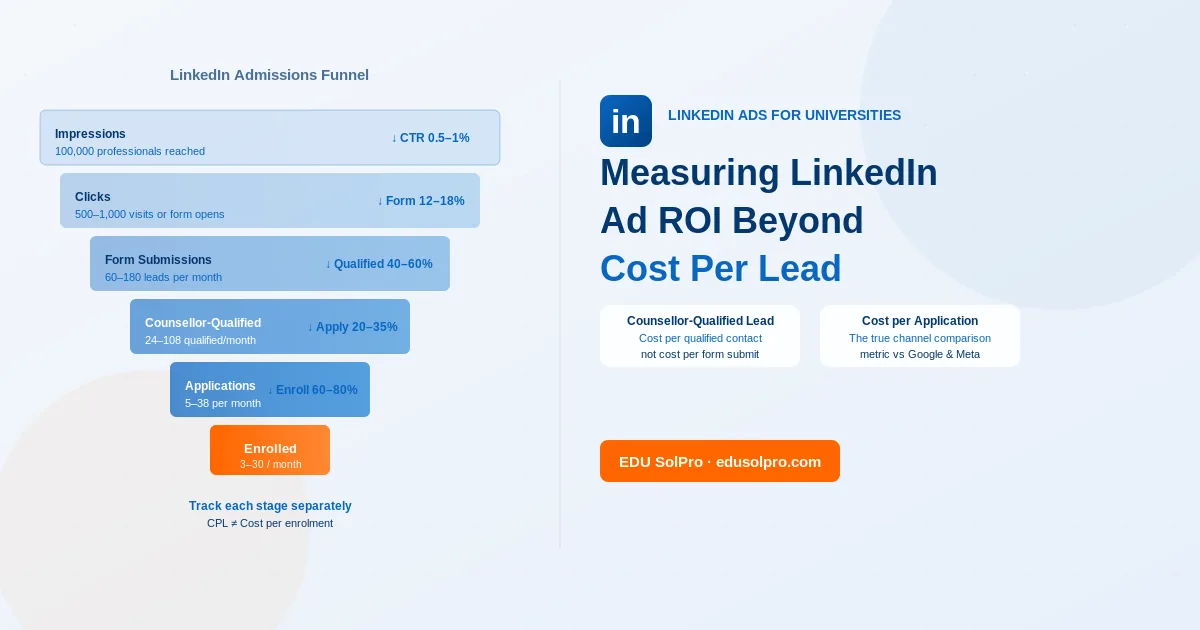
The 90-day timeline is important. Universities that look at LinkedIn results at 30 days and compare them to their Google campaigns are comparing the wrong stage of each channel’s lifecycle. Google delivers results from day one because it’s responding to active search intent. LinkedIn builds results over time as it optimises towards the best-performing audience segments and creative. The cost per qualified lead on LinkedIn typically drops 20 to 30% between month 1 and month 3 as the campaign matures.
See how this played out in practice: the CEPT University case study covers a specialist Master’s campaign across seven programmes where professional audience targeting produced the clearest conversion results.
Our guide on LinkedIn Lead Gen Forms for university admissions covers how to get leads from LinkedIn into a counsellor’s hands quickly. For how LinkedIn fits into the broader paid media mix, our post on performance marketing for universities covers the full channel picture.
Our LinkedIn Ads service for universities covers programme-specific audience builds, creative development, and 90-day campaign optimisation for Indian PG admissions.
Frequently Asked Questions
How long does it take for LinkedIn Ads to produce applications, not just leads? The lead-to-application cycle for PG admissions in India is typically 4 to 12 weeks from the first inquiry, depending on the programme type, fee level, and how aggressively the counsellor team follows up. LinkedIn campaign results in terms of enrolled students are best evaluated at the end of an admissions cycle, not month by month.
Should universities use LinkedIn Ads for distance learning programmes differently from campus programmes? Yes. Distance learning campaigns can run nationally, with different geographic segments tested to identify which cities produce the best lead quality. Campus programme campaigns should concentrate budget on feeder states where both brand recognition and practical attendance are feasible. The creative also differs: distance learning ads should address concerns about online learning quality and employer recognition; campus ads should address the experience and network value.
What is a realistic CPL for LinkedIn Ads in Indian PG admissions? Cost per lead on LinkedIn for PG admissions in India typically ranges from ₹800 to ₹1,800 per lead, depending on audience specificity, programme prestige, creative quality, and whether Lead Gen Forms or landing pages are used. Lead Gen Forms tend to produce lower CPL because completion rates are higher. The CPL comparison to Google or Meta is less meaningful than the cost per counsellor-qualified lead, where LinkedIn typically performs more competitively.
Can LinkedIn Ads help build brand recognition alongside lead generation? Yes. Sponsored Content campaigns with a Brand Awareness objective can run at lower cost to build familiarity among the target professional audience before switching to a Lead Generation objective during peak admissions season. This works particularly well for universities with less brand recognition in a competitive market — the awareness-phase exposure makes the lead generation phase ads more likely to be trusted.
Do LinkedIn Ads work for PG programmes from state universities versus private universities? The platform doesn’t distinguish. What matters is whether the programme has a clear professional applicant profile that can be targeted on LinkedIn and whether the university can communicate a compelling career outcome in the ad creative. State university programmes with strong placement records and clear industry relevance can run effective LinkedIn campaigns. The common gap is in creative development and landing page quality rather than platform suitability.