A lot of university LinkedIn campaigns are essentially running Facebook logic on a different platform. Set a broad audience, keep the numbers large, let the algorithm optimise. On Meta, that approach is defensible. On LinkedIn, it produces an expensive list of clicks from people who are nowhere near ready to apply for a postgraduate programme.
LinkedIn’s value is specificity. The platform knows things about its users that no other ad network can match for accuracy: current job title, years worked, industry, company size, degree level. That data is there because users entered it themselves, because LinkedIn is a professional network and that information is the point of the profile.
This is a walkthrough of how to build a LinkedIn audience for a PG admissions campaign, with the filters that matter and the logic behind each one.
Start with the applicant profile, not with the platform
The targeting setup is only as good as the applicant profile that sits behind it. Before opening LinkedIn Campaign Manager, the university needs a clear answer to one question: who specifically is this programme for?
Not “working professionals.” The specific person. An MBA in Operations Management from a university in Ahmedabad might be designed for plant supervisors, supply chain executives, and operations managers in manufacturing companies across Gujarat and Maharashtra, with 5 to 10 years of experience. That’s a targetable profile.
Vague profiles (“professionals who want to grow their career”) produce vague targeting, and vague targeting produces expensive leads that don’t convert.
Once the profile is clear, the targeting becomes an exercise in translation: which LinkedIn parameters most closely match the actual characteristics of the intended applicant?
Job title and job function: the first filter
Job title targeting is the most direct way to reach people in a specific professional role. LinkedIn allows targeting by exact job title or by job function, which covers a broader category of related titles.
For most PG admissions campaigns, job function targeting makes more sense than exact job title targeting, for one practical reason: titles vary widely across companies and geographies. The same person might be a “Operations Lead” at one company and “Deputy Manager – Manufacturing” at another. Job function covers both.
The job functions that typically produce the most relevant audience for common Indian PG programmes:
For an MBA or PGDM: Business Development, Finance, Operations, Information Technology, Marketing, Human Resources. These cover the mid-level professionals most likely to consider a general management qualification.
For an MCA or tech-focused MTech: Information Technology, Engineering, Product Management.
For an MBA in Healthcare Management or Hospital Administration: Healthcare, Research Science, Medical and Health.
For an MBA in Finance or MCom: Finance, Accounting, Business Development.
The targeting is not additive — someone who is in IT and in Finance is caught by either filter. Setting multiple job functions increases reach; setting fewer improves precision. For a tightly scoped programme with a very specific applicant profile, fewer functions and narrower targeting typically produce better leads at higher cost. For broader programmes, wider targeting at lower CPL can be tested against.
Seniority: filtering by career stage
Seniority on LinkedIn reflects where a user sits in their organisation’s hierarchy, not just years of experience. The options available in Campaign Manager are: Unpaid, Training, Entry Level, Associate, Mid-Senior Level, Director, Manager, VP, CXO, Partner, Owner.
For most 1 or 2-year Master’s programmes, the useful range is Entry Level through Mid-Senior Level, sometimes extending to Manager. This covers professionals who are:
- Established enough to know what a Master’s degree would do for their career (as opposed to fresh graduates who may not have context yet)
- Senior enough to have an employer relationship worth leveraging for education benefits
- Not so senior that a postgraduate degree feels irrelevant to their existing authority
Director and VP are occasionally worth including for Executive MBA or part-time PG programmes specifically designed for senior professionals who want to formalise their experience. Including them in a standard MBA campaign typically produces low engagement and high CPL.
Years of experience: the most underused filter
Years of experience is a filter that many university campaign managers skip, partly because it looks redundant alongside seniority. It is not.
Seniority describes where someone sits. Years of experience describes how long they’ve been working in total. Someone with 8 years of experience can be at Entry Level if they spent those years in roles that didn’t advance, or at Mid-Senior if they moved quickly. The two filters catch different things.
For PG admissions, years of experience tends to be the more predictive filter. A working professional with 4 to 8 years in a relevant industry is typically at the point in their career where a further qualification feels timely — specific enough to be useful, not so late that it disrupts an already-established career trajectory.
The right experience range depends on the programme:
A 1-year Executive MBA or PGDM typically targets 7 to 12 years of experience. A 2-year full-time MBA from a campus-based programme is more likely to attract 3 to 7 years. An MCA or MTech for IT professionals in senior individual contributor roles might target 4 to 9 years.
Running two campaigns with different experience ranges — one at 3 to 6 years, another at 6 to 10 years — and comparing the lead quality over 60 days is a standard way to identify which cohort converts best for a specific programme.
Industry: precision that Google Ads cannot match
Industry targeting on LinkedIn filters by the industry in which the user is currently employed, as self-reported in their profile. The taxonomy is broad (nearly 150 industries) but the main categories for PG admissions are clear.
For an MBA targeting professionals who want to move into management: Information Technology and Services, Banking, Financial Services, Pharmaceuticals, Healthcare, Manufacturing, Retail.
For healthcare-specific management programmes: Hospital and Health Care, Medical Devices, Pharmaceuticals, Research, Biotechnology.
For finance-specific qualifications: Banking, Financial Services, Insurance, Investment Management, Accounting.
The industry filter is particularly useful for universities that want to target specific sectors rather than run generic campaigns. A university with strong placements in the banking sector can target banking professionals specifically, with creative that references the career outcomes relevant to their industry context. A generic ad that mentions “strong placements” reaches everyone; an ad that says “three of our MBA alumni are now at Axis Bank, HDFC, and Kotak” and runs only to banking professionals is a different message entirely.
Company size: the underused qualifier
Company size is a targeting parameter that most university LinkedIn campaigns ignore. For some PG programmes, it’s one of the most useful filters available.
The logic is straightforward. Professionals at very small companies (under 50 employees) are often in generalist roles that don’t map to programme-specific applicant profiles, and their employers are unlikely to sponsor further education. Professionals at very large companies (10,000+ employees) often have internal training programmes and leadership pipelines that reduce the pull of an external PG qualification.
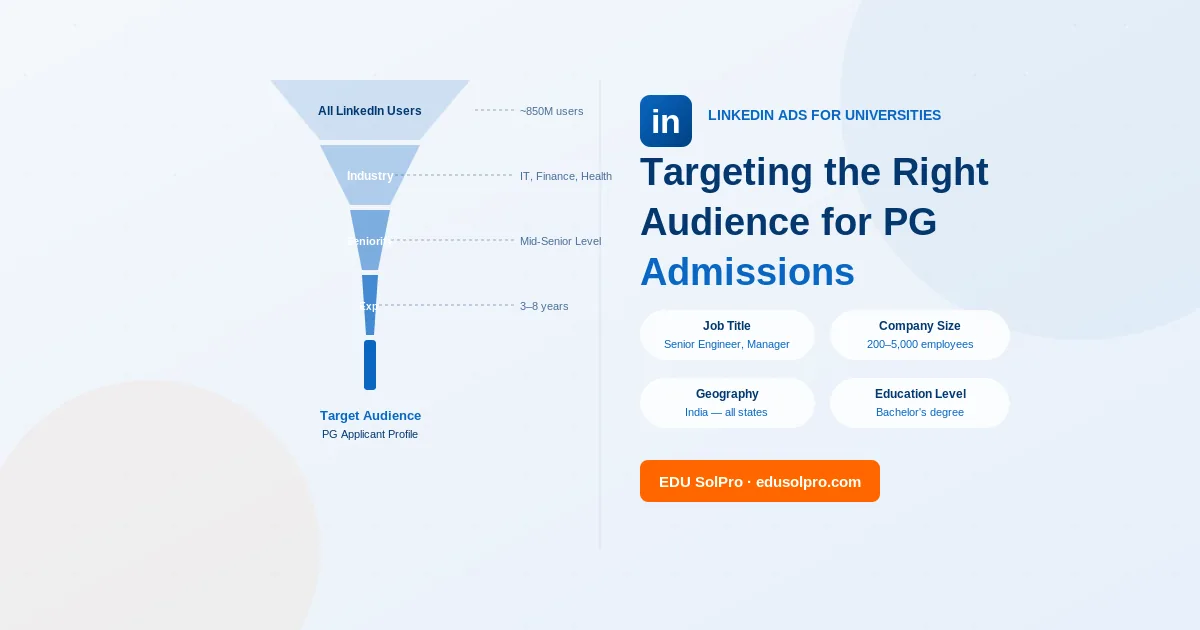
The middle range — 200 to 5,000 employees — is where PG admissions campaigns tend to find the best-qualified applicants. These are professionals in real industry environments, with enough organisational structure to have defined career tracks but not so much that an external qualification is redundant.
Company size targeting is worth testing explicitly for Executive MBA and part-time PG programmes. A professional at a 500-person company who sees an ad for a programme that promises “leadership skills for the next stage of your career” responds differently than someone at a 50-person startup who is already wearing five hats.
Geography: where Indian university campaigns go wrong
Most PG admissions campaigns in India set geography to the entire country. That’s often a mistake, not because the national audience isn’t relevant, but because it makes the campaign unmanageable and the creative too generic to say anything useful.
A university in Ahmedabad offering a full-time MBA will draw the majority of its applicants from Gujarat, Rajasthan, Maharashtra, and Delhi NCR — not equally from all 28 states. Running national campaigns at the same budget as regional campaigns means spending money in markets where the probability of conversion is low and brand recognition is minimal.
A more practical approach is to run city-level or state-level campaigns with creative that references the local context where appropriate. LinkedIn allows targeting by country, region (state), and city. Starting with the top 5 to 8 feeder markets based on past enrollment data and setting separate ad sets for each gives much better visibility into what’s working and where.
For distance learning and online programmes, national targeting makes more sense — the geography constraint disappears when the student doesn’t need to relocate.
Education level: separating postgraduate prospects from UG completers
LinkedIn allows targeting by member education: degree field, school, and degree level. For PG admissions, degree level targeting to “Bachelor’s Degree” (or equivalent) filters the audience to people who have already completed an undergraduate education — the prerequisite for any postgraduate programme.
This filter is worth including even when other filters are already quite specific, because it removes the small but real segment of users who list professional certifications or diplomas as their primary education but haven’t completed a Bachelor’s degree and therefore aren’t eligible for most PG programmes.
Targeting specific schools can be useful for alumni retargeting or for campaigns aimed at top-feeder institutions — a university that gets a high proportion of applications from graduates of specific engineering colleges can test ads targeted to alumni of those institutions.
Audience size: how big should the LinkedIn target audience be?
LinkedIn’s targeting documentation suggests a minimum audience size of 50,000 for Sponsored Content campaigns. In practice, PG admissions audiences that are smaller than this tend to produce unstable delivery and inflated CPL.
However, audiences that are too large — above 3 to 5 million for a regional campaign — often indicate that the targeting isn’t specific enough. The campaign will deliver, but the audience will include a meaningful proportion of people who don’t fit the applicant profile.
For a regional PG admissions campaign targeting specific industries, seniority levels, and experience ranges in a state or two, a well-built audience typically lands between 80,000 and 400,000 people. This is large enough for stable delivery and small enough that the creative can be fairly specific to the audience’s context.
If the audience comes out below 50,000, the most practical adjustment is to widen one layer — either add one more job function, extend the experience range by a year on either end, or add an adjacent state — rather than removing the most precise filters, which are usually the most valuable ones.
Layering vs OR logic: how LinkedIn audience targeting works
One technical detail that matters for how LinkedIn audiences are built: LinkedIn’s targeting filters within a category use OR logic (any of the selected options), while different categories use AND logic.
So if you select “IT” and “Finance” as industries, you reach users in IT OR Finance. If you set industry to “IT and Finance” AND seniority to “Mid-Senior Level and Manager,” you reach users who are in IT or Finance AND who are at Mid-Senior Level or Manager level.
This means that adding more options within a single category (more industries, more job functions) increases audience size. Stacking additional category filters (adding seniority on top of industry on top of experience) reduces it.
Building the audience down layer by layer and checking the estimated audience size after each layer is added is the practical way to find the right balance. The target is usually the smallest audience that is still large enough for stable ad delivery.
From targeting to creative
Audience targeting sets up who sees the ad. The creative determines whether they do anything about it.
The most consistent problem in LinkedIn PG admissions campaigns is precise targeting paired with a generic ad. If the targeting is reaching mid-level IT professionals in Bengaluru with 5 to 8 years of experience, the creative should speak to what an MCA or MBA means for someone in that exact situation. Not “Apply for MBA 2026 Batch.” Something that references their career stage, their industry, and what the programme would actually do for them.
Precise targeting gives the university enough information about who it’s reaching to say something specific. Using that information is where most campaigns leave money behind.
For the full picture of how LinkedIn Ads fit into the broader PG admissions funnel and how they compare to Google Ads for reaching working professionals, read Why LinkedIn Ads work better than Google Ads for Master’s programme admissions.
To see how this targeting approach worked in practice across seven specialist Master’s programmes, the CEPT University LinkedIn Ads case study covers audience construction, creative testing, and results from a 2026 campaign.
For more on how paid media sits alongside other digital marketing channels in university recruitment, our post on performance marketing for universities covers the full channel mix.
Our LinkedIn Ads service for universities handles audience strategy, targeting setup, campaign architecture, and creative development for PG admissions.
Frequently Asked Questions
What is the minimum LinkedIn ad budget to test audience targeting properly? A meaningful test of audience targeting requires at least 60 to 90 days of campaign runtime at sufficient budget to generate 40 to 60 leads per audience segment. For most Indian PG admissions campaigns, this means ₹60,000 to ₹80,000 per month as a minimum. Testing multiple audience segments simultaneously requires proportionally more, or a phased approach where segments are tested sequentially.
Can LinkedIn targeting reach alumni of specific universities? Yes. LinkedIn allows targeting by school (member education), which can be used to reach alumni of feeder institutions. This is particularly useful for universities that draw heavily from specific engineering or commerce colleges and want to reach their recent graduates in specific career stages.
What is the difference between LinkedIn job title targeting and job function targeting? Job title targets users whose listed title matches exactly or closely. Job function targets a broader category of related titles. Job function is usually more practical for PG admissions because professional titles vary widely across companies even for people in similar roles. A “Deputy General Manager – Operations” and an “Operations Head” are in the same function but would not both be caught by a specific title targeting either phrase.
Does LinkedIn allow retargeting website visitors? Yes. LinkedIn’s Insight Tag (a tracking pixel placed on the university website) allows building retargeting audiences of people who visited specific pages — the MBA programme page, the admissions page, the fee structure page — and then showing them targeted LinkedIn ads. This is a useful warm audience layer to run alongside cold audience campaigns.
How often should LinkedIn audience targeting be reviewed and adjusted? Targeting should be reviewed after the first 30 days with at minimum these checks: Is the audience delivering (is spend being used)? What is the click-through rate on each audience segment? What is the counsellor-qualified lead rate from LinkedIn leads? Segments that are spending but not producing qualified leads should be narrowed or replaced. Segments that are performing should be retained and potentially given more budget.