- Education lead generation is the process of identifying prospective students, capturing their interest, and collecting their contact information so your admissions team can nurture them toward an application and, ultimately, enrolment.
In practice, it means everything that brings a student into your pipeline: a Google search that lands on your course page, a Facebook ad that drives a form fill, a WhatsApp message that starts a conversation with your admissions counsellor, or a blog post that answers the question ‘Which MBA college is best for working professionals in Mumbai?’
- Lead generation for universities differs from that for schools because the decision cycle is different. University students take 3–6 months to research a programme before applying. School admissions happen in a compressed 8–12 week window. College lead generation for undergraduate programmes sits somewhere in between. For insights into the broader digital marketing landscape, read about digital marketing for universities. The strategies in this guide cover all three segments.
This guide covers 15 lead generation strategies for universities, colleges, and schools across India. Each includes what it is, how it works, and steps you can implement.
-
Why Education Lead Generation Is More Critical Than Ever in 2026 India has 760+ universities and 38,000+ colleges competing for the same pool of prospective students. Competition is fierce and digital. Consider these facts:
-
65% of institutions are now using AI and automation in their enrolment efforts — up from 40% in 2024
-
90%+ of students begin their institution search online before visiting a campus
-
The average Indian student explores 4–6 institutions before making a final decision
-
Education portals like Shiksha and Careers360 often rank above your own website— meaning you need a multi-channel strategy, not just a great website
-
Institutions that combine paid and organic lead generation see 2–3x more qualified enquiries than those relying on a single channel
Getting impressions but no clicks? Your content is visible but not competitive enough. Improve on-page SEO, deepen your content, and sharpen title tags and meta descriptions. Learn more about SEO mistakes universities make.
- Strategy 1 — Website Optimisation: Your #1 Lead Generation Asset Your website matters most. Over 90% of prospective students visit before enquiring. If they can’t find what they need in 30 seconds, they leave for a competitor’s site.
Programme-specific landing pages: Every course or degree needs its own page with clear eligibility, fees, career outcomes, and an enquiry form. Generic ‘Our Courses’ pages don’t convert.
-
Mobile-first design: Over 80% of student searches happen on mobile. If your forms are hard to fill on a phone, you’re losing the majority of your leads before they even start.
-
Fast loading speed: Google’s data shows that a 1-second delay in page load reduces conversions by 7%. Compress images, use WebP format, and eliminate render-blocking scripts.
-
Clear calls to action (CTAs): Every page should have one primary CTA — ‘Download Brochure’, ‘Apply Now’, or ‘Talk to an Admission Counsellor’. Avoid giving students too many choices.
-
Trust signals above the fold: Accreditation logos, ranking badges (NAAC, NIRF), alumni count, and placement statistics should be visible without scrolling.
-
Landing Page Optimisation for Education Lead Capture The best education lead generation websites use dedicated landing pages — not their homepage — for paid ad campaigns. A landing page should have one goal: convert a visitor into a lead. Remove the navigation menu, reduce distracting links, and keep the form short (name, phone, email, programme interest — nothing more).
-
Pro tip: Use a WhatsApp icon or click-to-WhatsApp button on every landing page. In India, WhatsApp enquiries convert 3–5x better than standard email forms because students get a response within minutes instead of hours.
-
Strategy 2 — SEO: Long-Term Organic Lead Generation SEO means your website shows up when students search for courses. Organic leads convert 30–50% better than paid leads because the student is already searching for what you offer.
For lead generation for universities and colleges, SEO focuses on three areas:
-
1. Programme-Specific Keyword Targeting Every degree programme should be optimised for the keywords students use when searching for it. These are called ‘long-tail keywords’ — more specific phrases that have lower competition but higher intent. Examples:
-
‘MBA in digital marketing in Ahmedabad’ — much easier to rank for than ‘MBA colleges in India’
-
‘BCA course fees in Gujarat’ — high intent, specific location
-
‘Part-time MBA for working professionals in Mumbai’ — captures a specific audience
-
‘NAAC A-grade university in Rajasthan’ — trust-signal search
-
2. Local SEO for Colleges and Schools-**Lead generation for schools ** and local colleges depends heavily on local SEO. When a parent in Surat searches ‘best CBSE school near me’, Google shows results based on Google Business Profile optimisation, reviews, and proximity. Ensure your institution has:
-
A fully completed and verified Google Business Profile
-
Consistent NAP (Name, Address, Phone) across all directories
-
50+ Google reviews with responses from your team
-
Location-specific pages on your website (e.g., ‘/mba-college-surat/’)
-
3. Content SEO — Blogging and Resource Pages Publishing regular, SEO-optimised blog content creates a steady stream of organic leads over time. Topics like ‘Top 10 MBA Colleges in Gujarat 2026’, ‘What is the scope of BCA in India?’, or ‘How to apply for NEET 2026’ attract students in the research phase and build your institution’s authority.
Publishing data: Institutions that publish 2+ SEO-optimized blog posts monthly see 30-40% organic traffic growth within 6 months. Blog posts generate leads for 3-5 years. See content marketing for strategy details.
| Stage | Student Mindset | Best Channel | Goal |
|---|---|---|---|
| Awareness | ”I want to explore options” | YouTube, Blog, Social Media | Build brand visibility; drive traffic |
| Interest | ”I’m comparing 3–4 colleges” | Email, Retargeting, Blog | Send programme details; build consideration |
| Intent | ”I’m ready to apply” | Google Ads, WhatsApp, Portals | Convert to application form |
| Application | ”Closing out my decision” | WhatsApp, Email, Live Chat | Remove objections; support application |
-
Strategy 3 — Google Ads & PPC for Education Lead Generation Google Ads gets results fast. Unlike SEO (which takes months), Google Ads generates enquiries within days. It’s the most effective paid channel for universities in India.
-
Search Ads for High-Intent Student Queries Search ads appear at the top of Google results when someone searches for specific keywords. For education, the highest-converting keywords are transactional — they signal that the student is ready to enquire. Examples: ‘MBA admissions 2026’, ‘BBA colleges in Pune fees’, ‘MBA in finance online India’.
-
India CPC benchmarks for education: Google Search Ads for education typically cost ₹5–₹50 per click, with an average cost per lead (CPL) of ₹50–₹300 depending on the programme and targeting.
-
YouTube Ads for Student Recruitment YouTube is India’s second-largest search engine. Students research careers and colleges on YouTube extensively. Running 15–30 second non-skippable ads — or longer ‘consideration’ ads — featuring campus tours, student testimonials, and faculty spotlights can drive significant awareness and enquiries.
Remarketing shows ads to students who visited but didn’t inquire. They already know your institution—they need a nudge. These ads cost 3-5x less because you’re reaching a warm audience. Retargeting increases click-through rates and lowers cost per lead.
- ⚠️ Common Mistake: Many institutions run Google Ads but send traffic to their homepage instead of a dedicated landing page. This kills your conversion rate. Always create a specific landing page for each ad campaign with a matching headline, a single CTA, and a short form.
- Strategy 4 — Social Media Lead Generation for Universities & Colleges Social media is the most targeted and cost-effective way to reach prospective students — especially Gen Z (born 1997–2012) and millennials. In India, students spend 3–5 hours per day on social media, making it a critical channel for college lead generation and brand building.
Facebook and Instagram Lead Ads capture student information directly in-app—no redirect needed. The student sees your ad, clicks, a pre-filled form pops up, they submit in 2 taps. This reduces friction and improves conversions.
Facebook’s targeting allows you to reach students by age (17–25 for UG, 25–35 for MBA), location (within 50km of your campus), interests (career development, specific industries), and education level. You can even target students who follow competitor institutions’ pages.
Instagram Reels drive student attention. Campus life, student experiences, placement drives, and faculty interactions reach more people than static posts. Institutions posting 3-5 Reels weekly see higher profile visits and form clicks. For UG students, Snapchat works well too—cheaper awareness-stage leads for ages 15-25.
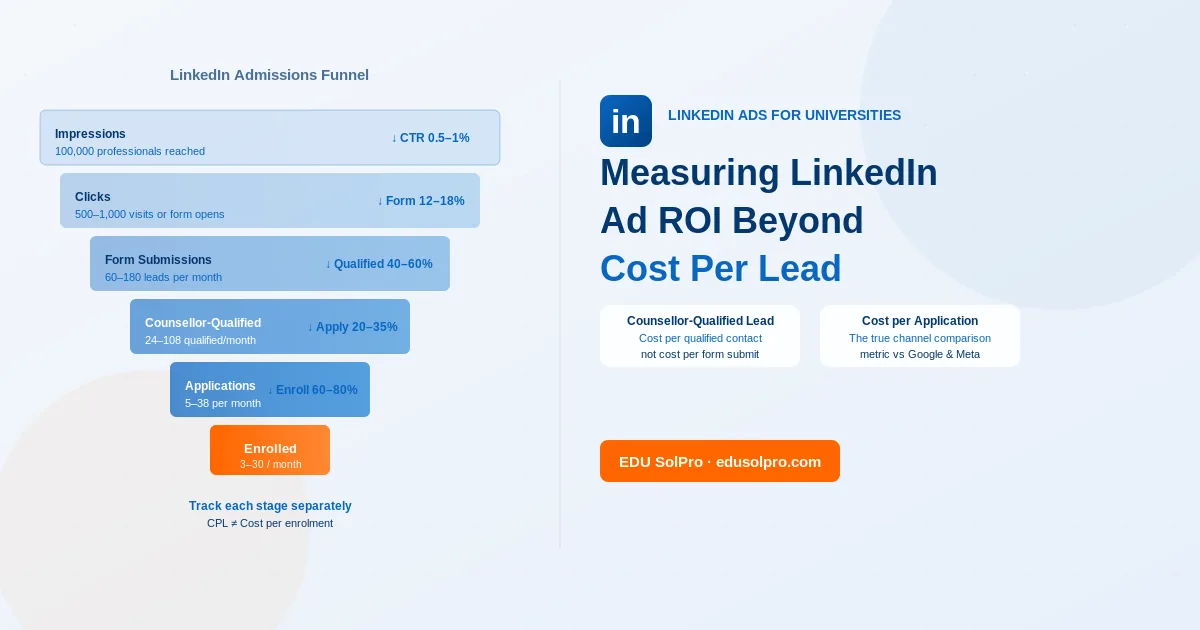
- LinkedIn for Postgraduate & Professional Programmes For lead generation for universities offering MBA, executive education, or professional development programmes, LinkedIn is the strongest platform. LinkedIn Lead Gen Forms target professionals by job title, industry, and experience level — ideal for reaching mid-career professionals looking to upskill.
-
💡 Platform Selection Guide: Use Facebook + Instagram for UG admissions (age 17–22), LinkedIn for MBA and executive programmes (age 25–40), YouTube for awareness and research phase, and WhatsApp for direct follow-up and nurturing.
-
Strategy 5 — WhatsApp Marketing for Lead Generation in Education (India-Specific) WhatsApp is the single biggest opportunity in education lead generation in India that most institutions are still underusing. With 500 million+ WhatsApp users in India, students use it more than email, and response rates on WhatsApp are 5–8x higher than email. For admissions teams, this is a game-changer.
-
WhatsApp Business API for Education Institutes-WhatsApp Business API (different from the free WhatsApp Business app) allows institutions to automate and scale their WhatsApp communication. Use it to:
-
Send automated responses to every enquiry form fill — instantly, 24/7
-
Create drip sequences: Day 1 (welcome + brochure), Day 3 (programme details), Day 7 (fee structure), Day 14 (application deadline reminder)
-
Broadcast admission season updates to opted-in students
-
Allow students to ask questions and get instant answers via chatbot, with seamless handoff to a human counsellor
-
WhatsApp Lead Capture: Practical Implementation Add a WhatsApp click-to-chat button on every page of your website and landing pages. Use the URL format: wa.me/91XXXXXXXXXX?text=Hi,%20I’m%20interested%20in%20[Programme]. This pre-fills the student’s WhatsApp message, making it effortless to start a conversation.
-
India benchmark: Institutions using WhatsApp Business API for follow-up see enquiry-to-application conversion rates of 15–25%, compared to 5–8% with email alone.
Use WhatsApp as a lead source: Run Facebook ads with ‘Send WhatsApp Message’ CTA. Students start conversations instead of filling forms, giving better engagement and higher-quality leads.
- Strategy 6 — Content Marketing & Blogging for Education Lead Generation Content marketing is the long-game strategy that turns your institution’s website into a lead-generation machine over time. It’s the process of creating and publishing valuable content — blog posts, guides, comparison articles, career resources — that prospective students are already searching for.
Many marketers rely on content marketing for lead generation. It works especially well in education because students research heavily—they read articles, watch videos, and compare options before inquiring.
-
High-Converting Content Types for Education Institutes-Course comparison articles:‘BBA vs BCom: Which Is Better for a Career in Finance?’ — targets students in the decision phase
-
Career guides:‘Top 10 Careers After MBA Marketing’ — captures students researching career outcomes
-
Admission guides:‘How to Apply for MBA in India 2026: Step-by-Step Guide’ — extremely high intent, converts well
-
FAQ articles:‘What is the NAAC accreditation and why does it matter?’ — builds trust and answers objections
-
City-specific college rankings:‘Top 10 MBA Colleges in Ahmedabad 2026’ — strong local SEO value
End every blog post with a clear CTA—‘Download the brochure’ or ‘Speak to an admission counsellor’. Content without a conversion pathway is just traffic.
-
Strategy 7 — Email Marketing & Lead Nurturing for Education Institutes Email is still one of the highest-converting tools in lead generation for education. Education emails have a 28.5% open rate — significantly higher than the 21.5% industry average. When a student fills an enquiry form, they’re not always ready to apply immediately. Email nurturing keeps your institution top-of-mind through their 3–6 month decision journey.
-
The Education Email Nurture Sequence After capturing a lead, trigger an automated email sequence. Here’s a proven structure:
-
Day 0 (Immediate): Welcome email + programme brochure PDF + a personal message from the admissions team
-
Day 2:‘Why students choose [Your Institution]’ — testimonials, placements, rankings
-
Day 5: Programme-specific email — curriculum breakdown, specialisations, faculty profile
-
Day 8: Financial aid and scholarship information — addresses one of the biggest objections
-
Day 12: Virtual campus tour link or webinar invitation — builds emotional connection
-
Day 18: Application deadline reminder — urgency trigger
-
Day 25: Final CTA — ‘Last few seats remaining. Apply by [date]’ — scarcity trigger
Email Segmentation works because not every student wants the same programme. Segment by programme interest, location, academic background, and funnel stage. Segmented emails drive more conversions than blasts.
Tools to use: HubSpot (best for large universities), Mailchimp (good for smaller institutions), LeadSquared (built specifically for education — highly recommended for Indian institutions).
-
Strategy 8 — Lead Generation for Schools: K-12 Specific Strategies-**Lead generation for schools ** is distinctly different from higher education. You’re marketing not just to students but primarily to parents — and parents make decisions based on different factors: academic reputation, safety, location, extracurriculars, teacher quality, and fees.
-
What Works for K-12 School Lead Generation-**Google Ads with hyperlocal targeting: ** Target searches like ‘best CBSE school in [your city area]’ with a 5–10 km radius around your campus. Parents search locally — rank locally.
-
Facebook ads for parents: Target parents (age 28–45) within 10 km of your school who have children in the 3–12 age group. Facebook’s parental targeting is highly accurate.
-
Open house and admission day events: School decisions are heavily influenced by campus visits. Run Facebook event ads for open days, show the campus through Reels, and use WhatsApp to confirm registrations.
-
Google Business Profile optimisation: Parents searching ‘school near me’ rely heavily on Google Maps results. A well-optimised profile with 50+ reviews, clear timings, and recent photos gets significantly more enquiry calls.
-
Parent referral programmes: Referral leads convert 30% better than leads from other channels. Incentivise current parents to refer prospective families with benefits like fee discounts, priority sibling admissions, or school merchandise.
-
Education portal listings: List your school on platforms like Shiksha, Justdial, and JustSchools. These platforms rank above school websites in many local searches.
-
Key Difference: For schools, your conversion window is narrow — Indian school admissions happen in a 2–3 month window (November to February for the following academic year). All your campaigns must be timed around this window with urgency messaging as the deadline approaches.
-
Strategy 9 — Lead Generation for Universities & Higher Education: Advanced Tactics Higher education lead generation involves long sales cycles and research-heavy decisions. An MBA student takes 3-6 months comparing options, visiting campuses, and checking placement records.
-
Managing the Long Decision Cycle The challenge: keeping your institution visible over a 3-6 month window. A June inquiry might not convert to an application until November. Without nurturing, students forget you and choose competitors who stayed in touch.
Structure your lead nurturing around the decision stages: Awareness (tell them about the programme), Consideration (show them why you’re better), Decision (make it easy to apply). Use email, WhatsApp, retargeting ads, and direct counsellor outreach at each stage. Marketing automation lets you run this entire sequence without manual effort — it’s how high-volume institutions stay present across a 6-month decision window without burning out their counselling team. Timing these touchpoints right also ties into your admissions marketing calendar — knowing when to push hard and when to nurture quietly.
-
Programme-Level Differentiation Create separate campaigns for each programme. MBA and B.Tech students search differently and have different motivations. Generic institution-wide campaigns get lower quality inquiries than programme-specific ones.
-
International Student Lead Generation For universities targeting international students, LinkedIn and YouTube are strongest. International students research via video—campus tours, student vlogs, faculty Q&As, and placement stories.
-
LinkedIn Ads: Target international professionals by country, industry, and job title for MBA and executive programmes
-
YouTube: Invest in authentic student vlog content in English — this performs 3x better than professionally produced promotional videos for international audiences
-
WhatsApp & Telegram: In Middle Eastern and African markets, WhatsApp is the primary communication channel — essential for international student follow-up
-
Strategy 10 — Education Portals & Aggregators Education portals are underutilized for lead generation. Shiksha, Careers360, CollegeDunia, and GetMyUni attract millions of students monthly and often rank above institutional websites in Google.
-
Shiksha.com: India’s largest education portal — 10M+ monthly visitors. Listing your institution with verified reviews and detailed programme pages generates significant enquiry volume.
-
Careers360.com: Strong for engineering, medical, and MBA colleges. Their paid listing packages include featured placement in search results and direct enquiry forwarding.
-
CollegeDunia: Popular with UG students. Their review platform is heavily used by students to compare options.
-
JEE/NEET counselling portals: Students use these after entrance exam results to shortlist colleges — a high-intent moment for immediate lead capture.
Manage your portal profile actively. Respond to questions, get student reviews, and update fees. Profiles with 20+ reviews and recent updates get 3-4x more inquiries than stale ones.
-
Strategy 11 — Video Marketing & YouTube Video is the strongest format for recruitment. Viewers retain more of a message when they watch versus read. For students making a major decision, video builds emotional connection better than text.
-
What Video Content Works Best for Education Lead Generation?-**Campus tour videos: ** A professional 3–5 minute campus walkthrough is the single most viewed video type on education institution YouTube channels
-
Student testimonials: Authentic, unscripted student experience videos — especially placement success stories — drive enquiry intent more than any other content
-
Faculty spotlights: 2–3 minute interviews with popular faculty members build credibility and attract academically-focused students
-
Day-in-the-life Reels: 60-second Instagram and YouTube Shorts showing authentic student life outperform polished promotional videos for Gen Z audiences
-
Webinar recordings:‘Ask the Admissions Team’ webinar recordings serve as evergreen lead generation content that students find through YouTube search
YouTube pre-roll ads work well because you can target students watching career planning, exam prep, or college vlog content.
-
Strategy 12 — Webinars & Virtual Open Days Virtual events capture leads at registration and attendees are clearly interested. Webinar conversion rates range from 5% to 20%, making them high-quality sources. They also support content marketing.
-
‘Ask the Admissions Team’ webinars: Monthly Q&A sessions where prospective students get answers directly — incredibly effective for removing objections and building trust
-
Virtual campus tours: Live-streamed 30-minute campus tours with a Q&A — good for students who can’t visit in person, especially international and out-of-state students
-
Alumni career sessions: A successful alumnus talking about their career journey is one of the strongest conversion tools for MBA and professional programmes
-
Career workshop webinars:‘How to Write the Perfect MBA Application Essay’ or ‘GMAT Preparation Strategy’, provide value to students and generate leads before they’ve even decided on an institution
Promote webinars through Facebook event ads, LinkedIn event posts, WhatsApp broadcasts to your existing enquiry database, and email campaigns. Collect name, email, phone, and programme interest at registration — this gives you a complete lead record for every attendee.
-
Strategy 13 — Social Proof & Testimonials Social proof is powerful in education. Students and parents trust peer reviews more than institutional claims. Show what other students and parents say.
-
Types of Social Proof That Drive Education Leads-**Video testimonials: ** A 60-second authentic student video saying ‘I got placed at [Company] after my MBA here’ is worth more than a full-page advertisement
-
Placement statistics:‘Average CTC ₹12 LPA, Highest CTC ₹45 LPA, 95% placement rate’ — specific numbers, not vague claims
-
Rankings and accreditations: NAAC grade, NIRF ranking, NBA accreditation — display these prominently with official badges, not just text mentions
-
Google and portal reviews: 50+ positive Google reviews with responses from your team significantly improve enquiry rates from local search
-
LinkedIn alumni success stories: Active alumni with impressive career trajectories are your best marketing asset — feature them in content regularly
-
Media mentions and awards:‘As featured in [Publication]’ or ‘Winner of [Award]’ builds instant credibility with first-time visitors
Collect testimonials systematically. After placements, ask 10-20 students for 60-second phone videos about their experience. Use across your site, social, YouTube, and ads. Authentic video testimonials are free and valuable.
- Strategy 14 — AI Chatbots & Live Chat Students expect instant answers. At 11 PM with a question about MBA fees, they won’t wait for morning email. Chatbots provide 24/7 answers, capturing leads teams would miss.
The education chatbot market is growing fast. Response speed directly correlates to conversion. In India, where students research nights and weekends, 24/7 availability matters.
-
What Education Chatbots Can Handle- Answer common questions: course eligibility, fees, hostel availability, placement data, admission deadlines
-
Collect lead information: name, contact number, email, programme interest, and preferred callback time
-
Guide students to the right programme based on their interests and academic background
-
Schedule callbacks with the admissions team for complex enquiries
-
Send immediate follow-up messages via WhatsApp after a chatbot conversation
Use tools like Landbot, Intercom, or a WhatsApp API-based chatbot for the best results in the Indian education market. Staff-led live chat during business hours for complex queries, with chatbot handling after hours.
- Strategy 15 — CRM & Marketing Automation Lead generation doesn’t end at form submission. The real work—nurturing and converting—happens after. A CRM with automation separates institutions converting 5-8% of leads from those converting 20-30%.
-
What a CRM Does for Your Admissions Team- Centralises all enquiries from Google Ads, Facebook, website forms, WhatsApp, and portals into a single dashboard — no lead falls through the cracks
-
Assigns leads automatically to the right counsellor based on programme, location, or round-robin allocation
-
Sets follow-up reminders and tracks every interaction — call, email, WhatsApp message — with each prospective student
-
Shows which marketing channels are generating the most — and best quality — leads
-
Automates email and WhatsApp nurture sequences triggered by specific actions (brochure downloaded, form filled, website page visited)
-
Recommended CRM Tools for Indian Education Institutes-**LeadSquared: ** Built specifically for education — the market leader in India. Integrates with Shiksha, Facebook Ads, Google Ads, and WhatsApp. Best for universities and large institutions.
-
HubSpot: Excellent for content-heavy lead generation and email marketing. Better for institutions with strong content strategies.
-
Zoho CRM: Cost-effective option for smaller colleges and schools. Good WhatsApp integration and local support.
ROI: Institutions implementing CRM and automation see 35-45% conversion rate increases within 6 months. Systems pay for themselves in one admission cycle.
- Channel Comparison: Which Strategy Is Right for Your Institute? Use this table to decide which lead generation strategies to prioritise based on your institution type, timeline, and budget:
Channel / StrategyBest ForTime to ResultsAvg CPL (India)Lead QualityEffortGoogle Search AdsUniversities, colleges (UG/PG)1–2 weeks₹1100–₹550Very HighMediumSEO / Content MarketingAll institution types3–6 monthsN/AHighHighFacebook & Instagram AdsUG colleges, schools1–2 weeks₹150–₹700Medium–HighMediumWhatsApp MarketingAll (especially India)Immediate₹20–₹80Very HighLow–MediumEmail NurturingUniversities, MBA2–4 weeks₹15–₹60 [Depends on the tool]HighMediumEducation PortalsColleges, universities1–4 weeks₹100–₹400MediumLowLinkedIn AdsMBA, executive education2–3 weeks₹300–₹900Very HighMediumWebinars / Virtual EventsUniversities, MBA2–4 weeks₹50–₹150Very HighHighYouTube Ads + VideoAll institution types2–6 weeks₹30–₹100Medium–HighHigh
-
How to Measure Your Education Lead Generation: KPIs & Metrics Tracking the right metrics is what separates institutions that improve their results quarter over quarter from those that spend the same budget with the same mediocre outcomes. These are the KPIs every institution should track:
-
Volume Metrics (Are you getting enough leads?)-**Total enquiries per month: ** The baseline — track by channel to understand which sources work best
-
Cost per lead (CPL): Total spend ÷ total leads. Benchmark: ₹50–₹300 for paid, ₹10–₹50 for organic
-
Impressions and reach: How many students are seeing your ads or content? Low impressions = low visibility, no matter how good your creative is
-
Quality Metrics (Are you getting the right leads?)-**Lead-to-application rate: ** What % of enquiries actually fill an application? Industry average: 5–15%
-
Application-to-enrolment rate: What % of applicants actually enrol? These measures both lead quality and your admission process effectiveness
-
Cost per enrolment: The ultimate metric — how much are you spending to enrol one student? This should decrease year over year as your organic channels grow
-
Engagement Metrics (Are your strategies building a pipeline?)-**Email open rate: ** Target 25–35% for education. Below 20% indicates poor segmentation or subject line quality
-
Website enquiry form conversion rate:% of visitors who fill an enquiry form. Industry average 2–5%; well-optimised pages can reach 8–12%
-
WhatsApp response rate: What % of WhatsApp messages get a reply from the student? This indicates lead interest level
-
Monthly Review Cadence: Review CPL and total enquiry volume weekly. Review lead quality (enquiry-to-application rate) and channel performance monthly. Review cost per enrolment and annual ROI quarterly. This rhythm allows you to catch underperforming campaigns early and reallocate budget to what’s working.
Frequently Asked Questions
What is education lead generation?
Education lead generation is the process of identifying, attracting, and capturing prospective students for schools, colleges, and universities using digital marketing strategies like SEO, paid ads, social media, WhatsApp marketing, and content marketing to drive student enquiries and boost admissions. In India, education lead generation has become a critical competitive tool as more than 38,000 colleges compete for a limited pool of students each year.
How much does lead generation cost for universities in India?
The cost of education lead generation in India varies significantly by channel and programme type. Google Search Ads typically cost ₹5–₹50 per click with an average CPL of ₹80–₹300. Facebook and Instagram Lead Ads deliver leads at ₹50–₹200. Organic channels like SEO and content marketing have no per-lead cost but require 3–6 months of consistent investment and strategic execution before generating significant volume.
What are the best lead generation strategies for colleges?
The most effective strategies for college lead generation are: (1) Google Ads for capturing high-intent students actively searching for courses, (2) Facebook and Instagram Lead Ads for targeted student reach, (3) WhatsApp marketing for the highest response rates in India, (4) SEO and content marketing for long-term, low-cost organic leads, (5) email nurturing to convert enquiries into applications, and (6) education portal listings on Shiksha and Careers360.
How can universities generate more student leads online?
Universities looking to generate more student leads online should: optimise each programme page for specific keywords (‘MBA in finance admission 2026’), run Google Ads targeting high-intent search queries, use WhatsApp Business API for instant enquiry follow-up, publish SEO-optimised blog content answering student questions, and implement a CRM to manage and nurture leads systematically. Lead generation for universities also benefits from LinkedIn Ads for MBA and executive programmes, and YouTube video content for international student recruitment.
Which platforms work best for education lead generation in India?
In India, the most effective platforms for education lead generation are: Google Search Ads (highest-intent leads), Facebook and Instagram (volume and targeting), WhatsApp Business API (highest response and conversion rates), Shiksha and Careers360 portals (high student traffic), YouTube (awareness and international students), and LinkedIn (postgraduate and professional programmes). The best results come from combining 3–4 channels with a CRM to manage and nurture all incoming leads centrally.
How long does it take to see results from education lead generation?
Google Ads and Facebook Lead Ads can generate student enquiries within 1–2 weeks of launch. WhatsApp campaigns show results almost immediately. SEO and content marketing typically take 3–6 months to generate significant organic volume, but the leads they produce are higher quality and lower cost over time. The recommended approach is to use paid channels for immediate results while simultaneously building organic presence for sustainable, long-term lead generation.
- Conclusion: Building a Sustainable System
Modern lead generation isn’t one tactic. Successful institutions use: paid ads for immediate results, SEO for long-term organic traffic, WhatsApp for fast responses, CRM for tracking, and video for credibility.
Start with 2-3 strategies based on budget, measure results, then expand. Most institutions losing students aren’t losing because their programmes are poor—they’re losing because students don’t find them. Fix visibility first.
Related Resources
Explore more from EDU SolPro to strengthen your institution’s digital marketing:
- Lead Generation Services For Universities
- Paid Advertising Campaigns
- Website Design And Cro For Universities
- Marketing Budget Tips For Education Institutes
- Student Recruitment Strategies
Need expert help with your university’s digital marketing? Contact EDU SolPro for a free strategy consultation.