A Marketing Head at a mid-tier engineering college in Bangalore told me recently: “We spend ₹40 lakhs a year on digital marketing but have no idea if it’s working. We get inquiries, sure, but we don’t know which channel brought them. Half our budget goes to Google Ads. The other half is split between Facebook, Instagram, and something our previous intern set up. We have no attribution, no plan.”
This is common. Universities run digital campaigns separately with no system connecting them. A website, Facebook, Google Ads — but no attribution linking clicks to enrollments. The result is activity without clarity on actual impact.
A university marketing audit is the diagnostic step. It answers: “Where is my digital strategy working? Where is it broken? What should I fix first?”
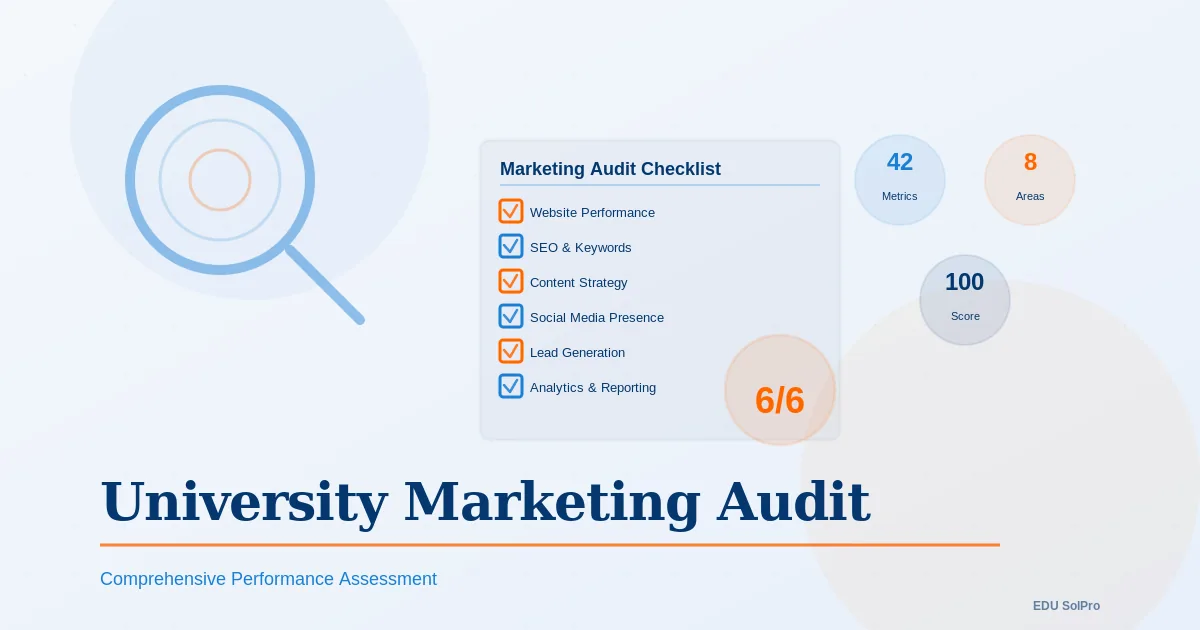
This framework will take you through six audit areas. For each, I’ll show you what good looks like, what bad looks like, and specific checks you can run right now.
Audit Area 1: Website and SEO
Your website is your digital front office. It’s where students land after searching Google, clicking an ad, or following a link from Instagram. If your website is broken or invisible on Google, you’re fixing a leak with a bucket underneath instead of a plug. See SEO mistakes universities make for a catalogue of the most common technical and content gaps.
What good looks like:
- Your program pages (B.Tech Computer Science, MBA, BCA) rank on the first page of Google for relevant keywords in your city or region.
- Your homepage loads in under 2 seconds on a smartphone.
- Your site architecture is clear: students can find application instructions, fees, placement data, and hostel information within 3 clicks from the homepage.
- Your website has a blog with 20+ articles on topics students care about: “How to get a scholarship,” “What is placement success?”, “Difference between B.Tech and B.Sc.”
- Your website tracks visitors in Google Analytics 4, and you know what pages bring enrollment inquiries.
What bad looks like:
- Your website doesn’t rank for any of your target keywords. When a student searches “engineering colleges in Bangalore,” your site doesn’t appear.
- Your site is built on an old platform (Wix from 2015) or is a half-finished rebuild that was started 18 months ago and abandoned.
- Your admissions process requires students to download a PDF application form, fill it by hand, and email it back.
- Your website has a “News” section with articles from 2022 and a “Faculty” page that lists only three faculty members (because the others haven’t sent photos).
- Your website crashes or loads very slowly on smartphones.
Audit checks (run these today):
-
Open Google Search Console (if you don’t have access, ask your IT team or whoever manages your domain). Look at the “Performance” report. What keywords does Google say your site ranks for? List the top 20. Are these the keywords you want students to find you on?
-
Search Google for three keywords you want to rank for: “[Your City] engineering colleges,” “[Your Program Name] [Your City],” and “[Your Competitor Name].” Does your site appear on page 1? If not, you have an SEO problem.
-
Visit your website on a smartphone. Does it load in under 3 seconds? Open your program pages. Can you find the application link within 3 clicks? Can you find fees, hostel details, and placement data within 5 clicks?
-
Count the articles on your blog published in the last 12 months. Is it fewer than 5? That’s a problem. You need at least one article per month.
-
Check your website’s structure. Are program pages organized logically? Can a student who wants to apply to B.Tech Computer Science find that page directly, or do they have to navigate through “Academic Offerings” → “Engineering” → “Computer Science”?
Audit Area 2: Paid media (Google Ads, Facebook Ads, Instagram)
Paid media is your fastest way to drive awareness and inquiries, but also where universities waste money. Unfocused spending across too many campaigns with unclear targeting yields poor returns. Focused campaigns with clear conversion tracking cost less and deliver more. It’s not about budget size; it’s about focus.
What good looks like:
- You have separate Google Ads campaigns for different programs. Your B.Tech campaign targets “B.Tech colleges” keywords. Your MBA campaign targets “MBA programs” keywords. Not one generic “Admissions” campaign.
- You know your cost per inquiry for each campaign. You can say: “Our B.Tech Google Ads campaign costs ₹400 per inquiry. Our MBA campaign costs ₹600 per inquiry.”
- You can track from click to enrollment. A student who clicked your Google Ad can be linked back to that ad once they enroll.
- You’ve set up conversion tracking in Google Ads. Google knows when a visitor fills your inquiry form.
- Your Facebook and Instagram campaigns are seasonal. You spend more (April-August) when students are actively researching colleges. You spend less (September-March) when they’ve already enrolled.
- Your campaign budgets are allocated based on previous performance, not guesswork.
What bad looks like:
- You have one generic “Admissions” campaign running to all of India with a budget of ₹5 lakhs per month. You have no idea which program gets clicks, who converts, or what’s working.
- Your ads are running to cold audiences (everyone aged 16-30 in India) rather than warm audiences (people who’ve visited your website).
- You set a campaign to run for 6 months with a fixed daily budget and never check the results.
- Your Facebook and Instagram ads are images of your campus building with text like “Join us for a great future!” No specific call to action, no urgency, no clarity on what program or what the offer is.
- You don’t track cost per inquiry or cost per enrollment. You only know total spend.
- You’re running Google Ads to your homepage instead of directly to your application page or program page.
Audit checks (run these today):
-
Open your Google Ads account (ask your IT or marketing person if you don’t have access). Look at the “Campaigns” tab. How many campaigns do you have? Are they organized by program or by platform? If you have one campaign called “General Admissions,” restructure.
-
For each campaign, look at the “Conversions” column. Google should be tracking form submissions or page views as conversions. If the “Conversions” column is blank or zero, conversion tracking isn’t set up. Fix this immediately.
-
Open the “Search Terms” report. What keywords are your ads appearing for? Look for wasteful keywords like “free colleges India” or “college memes” that are likely from unqualified clicks.
-
Check your conversion rate. If your B.Tech campaign has 10,000 clicks and 50 conversions, your conversion rate is 0.5%. This is reasonable. If it’s 0.1%, your landing page or ad copy needs work.
-
Calculate cost per inquiry. Take your total spend and divide by conversions. If you spent ₹2 lakhs and got 400 conversions, your cost per inquiry is ₹500. Is this reasonable for your institution and geographic area? Benchmark against your peers.
Audit Area 3: Content
Content is the second-order effect. The student who searches “How to get into an engineering college” and finds your blog article will later search “engineering colleges near me” and remember your name. You’ve built trust through content.
What good looks like:
- You have a content calendar that covers topics students actually care about: admissions timelines, scholarship eligibility, hostel life, faculty expertise, placement outcomes.
- Your articles rank for keywords with search volume. Your article on “How to choose between engineering colleges” ranks on page 1 for that keyword.
- Your content is updated regularly. Old articles (with outdated fees or admission dates) are revised, not left to rot.
- You repurpose content across channels. An article becomes a video, then a social post, then a quote in an email.
- Your alumni and faculty occasionally write guest articles or are quoted in your articles. This adds credibility.
What bad looks like:
- Your blog exists but hasn’t been updated in a year.
- Your articles are written in vague, promotional language: “Our college is best for your future” rather than specific, helpful language: “Here’s how our Computer Science program compares to three peers on placement outcome and fees.”
- Your articles are very long (3,000+ words) and feel like a wall of text. No subheadings, no lists, no scannable format.
- Your content is the same across all channels. Your Instagram post is the same text as your email newsletter as your Facebook post. No adaptation for platform or audience.
- Your only content is “News” articles: “Dr. Sharma inaugurated the new lab” or “Students won a hackathon.” No content that answers prospective students’ questions.
Audit checks (run these today):
-
Open your blog. How many articles have been published in the last 3 months? Fewer than 3? You have a content problem. Good pace is 1 article per week.
-
Open your analytics and look at traffic sources. How much traffic comes from Google organic search (as opposed to Google Ads)? If it’s less than 20% of your total traffic, your content isn’t ranking for anything.
-
Look at three of your most recent blog articles. For each, answer: “What keyword did I write this article to rank for?” If you can’t answer that, the article was written without SEO intent.
-
Pick your best-performing content (highest page views). Can you identify why it performed well? Was it a top-of-funnel topic (broad interest) or bottom-of-funnel (specific to your institution)?
-
Check your content across platforms. Find one blog post. Did you also create an Instagram carousel or a YouTube video on the same topic? If not, you’re not maximizing content value.
Audit Area 4: Lead management and CRM
An inquiry arrives via your website form, a phone call, or a WhatsApp message. What happens next? If your answer is vague, “Someone follows up”, you have a lead management problem.
What good looks like:
- All inquiries flow into one CRM system (HubSpot, Salesforce, Pipedrive, or even a spreadsheet).
- Within 30 minutes of inquiry, the student gets an automated WhatsApp or SMS confirmation.
- Within 24 hours, a human from your admissions team calls or messages the student.
- Your CRM tracks the inquiry source: Google Ads, Facebook, organic search, email campaign, etc. So you know which channel brought the lead.
- Your CRM has a pipeline. A lead moves from “New Inquiry” to “Interested” to “Application Started” to “Application Complete” to “Admitted” to “Enrolled.”
- You run reports weekly: How many inquiries did we get? How many moved to “Interested”? How many moved to “Enrolled”? This is your funnel.
What bad looks like:
- Inquiries come into different channels: website form, email, WhatsApp, phone calls. Nobody has a central system to track them all.
- An inquiry from Google Ads is lost because the admissions office doesn’t know how to log it in the CRM, or nobody has logged it yet.
- You get an inquiry on a Friday evening and follow up on Monday. The student has moved on.
- You have no way to know why an inquiry never became an application. Did the student lose interest? Did they enroll elsewhere? Were you too slow to follow up?
- Your follow-up is a generic email chain copied and pasted to every inquiry. No personalization.
Audit checks (run these today):
-
Ask your admissions team: “What CRM do we use to track inquiries?” If you get a blank stare, you don’t have one. This is a blocker.
-
Ask: “If I generate an inquiry on your website right now, what happens in the first 30 minutes?” If the answer is vague or uncertain, your process is broken.
-
Pick a random inquiry from last month. Can you trace its journey? Can you see when it arrived, what channel it came from, when it was followed up, and what happened? If you can’t, your tracking is poor.
-
Run a simple number: How many inquiries did you get last month? How many became applications? What’s your inquiry-to-application conversion rate? If you don’t know this number, lead management is not a priority.
-
Check your team’s response time. What’s the time lag between inquiry and first follow-up? Is it 30 minutes, 3 hours, or next day? Benchmark against your own standard.
Audit Area 5: Reputation and reviews
Students read reviews. They ask current students on Quora and Instagram what a college is really like. What they hear shapes enrollment decisions.
What good looks like:
- Your institution has a Google Business Profile with 50+ reviews, average rating 4.2+/5.
- Your college name on Quora is associated with helpful answers about your programs, your culture, your placements.
- You have regular Instagram stories and posts from current students (not only official photos). Prospective students see real campus life.
- You monitor mentions of your institution on social media and review sites. You respond to negative reviews professionally and to positive reviews with gratitude.
What bad looks like:
- Your Google Business Profile has 5 reviews, average 3.2/5. One 1-star review from a student who says “Worst college ever” with no detail.
- Your college has no reviews on Shiksha.com or AskMe.com.
- Your Quora mentions include threads like “Is [Your College] a scam?” with no official response.
- Someone posted a negative tweet about your college 6 months ago complaining about hostel food. Nobody from your institution has acknowledged or responded.
- Your Instagram posts get 20 likes and zero comments from current students.
Audit checks (run these today):
-
Search Google for your college name. Click on your Google Business Profile. Check your star rating and number of reviews. Is the rating above 4? Below 3.5 is a problem.
-
Search your college name on Quora. Scan the first 10 questions and answers. Is there negative content? Is there a response from your institution? If not, consider reaching out.
-
Check your Instagram followers and engagement. Pick your last 5 posts. What’s the average number of likes and comments? Is engagement growing or declining?
-
Do a site search on Google: “site:reddit.com [Your College Name]” or “site:quora.com [Your College Name].” What do people say about you?
-
Google “[Your College Name] reviews.” What comes up? Is your Google Business Profile first, or are review sites ranking higher? If negative review sites are ranking high, you have a reputation problem.
Audit Area 6: Analytics and attribution
Analytics shows you what happened. Attribution shows you why it happened. Most universities have Google Analytics installed but don’t use it to answer real questions: “Which marketing channel actually drove my enrollment?”
What good looks like:
- You have Google Analytics 4 installed and connected to your CRM.
- You can answer: “A student who clicked my Google Ad, visited my website, downloaded my brochure, and filled an inquiry form is in my system as coming from Google Ads.”
- Your GA4 setup tracks key events: form submissions, PDF downloads, video views, “Apply Now” clicks.
- You run a monthly report showing: total website visitors, visitors by channel (Ads, Organic, Direct, Social), and conversion rate by channel.
- You know your cost per acquisition. If you spent ₹2 lakhs on Google Ads and got 50 enrollments, your cost per enrollment is ₹4,000.
What bad looks like:
- Your GA account exists but nobody logs into it. You have no dashboard, no reports, no review process.
- GA is set up but not connected to your CRM. So GA shows 1,000 website visitors but your CRM shows 50 inquiries. You don’t know which of the 950 others bounced, which were uninterested, which were existing students, etc.
- You track all visits but not actions. You know 10,000 people visited your site but not how many downloaded a brochure or filled a form.
- Your report is a PDF sent once a year to the VC. No weekly or monthly review, no action based on data.
Audit checks (run these today):
-
Access your Google Analytics 4 account. Go to “Reports” → “Life cycle” → “Acquisition.” What does your traffic breakdown look like? Should be roughly: Organic 40%, Paid 30%, Direct 20%, Social 10%. If one channel is 70% of traffic, that’s a dependency risk.
-
Go to “Reports” → “Engagement” → “Events.” What events are you tracking? You should see form submissions, video views, button clicks. If you see none, event tracking isn’t set up.
-
Look at your conversion rate by channel. Go to “Reports” → “Lifecycle” → “Conversion.” Does one channel convert better than others? If your Organic traffic converts at 3% but your Ads traffic converts at 0.5%, you need to improve your landing page experience for Ads traffic.
-
Ask your team: “What is our cost per inquiry?” If they don’t know, analytics isn’t being used for business decisions.
-
Create a simple Google Sheets tracker: Week, Total Spend, Total Inquiries, Cost Per Inquiry. Fill in the last 4 weeks. Is cost per inquiry trending up or down? This is your leading indicator.
The honest next step
Running through these six audits, you’ll find gaps. Some universities will find one or two big problems; others will find all six areas need work. That’s the point of an audit. For a strategic approach to addressing all areas systematically, read our guide on digital marketing for universities.
Here’s what I recommend:
- If you have strong fundamentals (website ranks, CRM tracks inquiries, analytics connected), you can fix most problems yourself with your team. Start with your lowest-converting area.
- If you have multiple broken areas or no clear ownership, you likely need external expertise. Not everything, but at least a month-long engagement to set up systems and train your team.
Some universities will choose the DIY path. Others will bring in an agency to audit, fix, and train. Either way, the act of running this audit means you now know where you stand. And you have a roadmap.
Key Takeaways
- A university marketing audit diagnoses what’s working and what’s broken across six areas: website/SEO, paid media, content, lead management, reputation, and analytics.
- Most universities excel at one or two areas and neglect the others, creating gaps in their funnel.
- Running through the six audit checks above takes 3-4 hours and costs nothing.
- The goal is not perfection in all six areas; it’s clarity on which areas are leaking enrollment and which are strong.
Next Steps
If you’ve run through this audit and found gaps, you have two choices.
Choice 1: Fix it yourself. Your team identifies the highest-impact gaps and commits to fixing them quarterly. Appoint an owner for each area.
Choice 2: Get expert help. EDU SolPro’s auditing and strategy services include a deep dive into all six areas, a diagnostic report, a 90-day action plan, and support in executing it. We typically work with universities where marketing is important but there’s no dedicated CMO.
For deeper reading on specific areas, check out our guide on education lead generation.