Most universities treat their NIRF perception score like a lottery ticket. They hope the right people know their name, submit feedback, and move on. The reality is far more controllable.
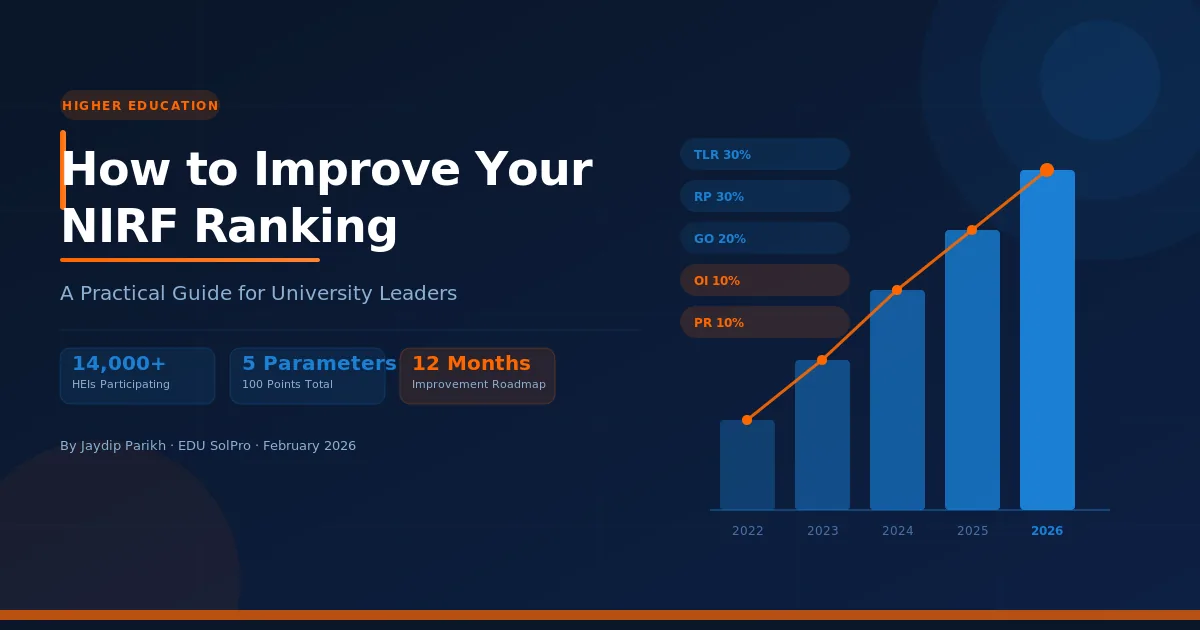
The Perception (PR) parameter carries just 10% of your overall NIRF score, but it’s the one parameter where institutional effort actually translates directly into results. Unlike research publications (which take years to accumulate) or teaching infrastructure (which requires capital investment), perception can shift in months.
This article walks through exactly how the NIRF perception score is calculated, why most universities underperform here, and five specific tactics that work.
How the NIRF perception score actually works
The Perception parameter measures reputation among three distinct groups: employers, academics, and research investors. NIRF conducts nationwide surveys across multiple sectors and regions, asking respondents to list institutions they believe produce strong graduates or contribute meaningfully to research.
The parameter has two sub-components, each carrying equal weight:
- Peer Perception for Employers and Research Investors (PREMP) - employers and industry professionals rate your institution based on graduate quality and research relevance
- Peer Perception for Academic Peers (PRACD) - academics at other institutions rate your research quality and institutional reputation
Both are weighted equally in the final PR calculation. This means your institution gets credit only if two distinct audiences mention you: people who hire your graduates, and people who know your research. A university might have excellent teaching but zero perception if employers don’t know about it. Similarly, a university with strong research but poor industry connections will underperform on PREMP.
Here’s the critical detail: NIRF doesn’t survey everyone. The survey list is curated. It includes employers from “reputable organizations,” academics from institutions they consider relevant, and professionals they identify as credible respondents. If your institution isn’t visible to these specific groups, you’re scoring zero points with them regardless of your actual quality.
The survey process is straightforward. NIRF sends surveys nationally to pre-identified respondents across industries, sectors, and academic disciplines. Respondents are asked to rank top institutions in their field or nominate institutions they believe in. They can write in institutions not on the list. Their responses are aggregated, weighted, and converted into your PR score.
This is why perception is easier to influence than it appears. You’re not competing for the attention of 1.4 billion Indians. You’re competing for the mindshare of roughly 5,000 to 7,000 carefully selected survey respondents nationally. That’s manageable. If only 20% of survey respondents know and mention your institution, you’re scoring in the mid-tier. If 40% mention you, you’re likely in the top 50. If 60%+, you’re in the top 20. The difference between 20% and 40% is purely visibility, not quality.
Why universities score below their actual quality on perception
Three institutional blind spots explain why most universities underinvest in perception:
Universities assume perception is automatic. Your college produces good graduates and research. Surely people know this. They don’t. Knowledge concentration in academia is real. A professor at a Delhi university might not know your institution exists unless you actively put your faculty and research in front of them.
The survey methodology isn’t transparent. NIRF doesn’t publish the list of survey recipients. This makes universities treat perception as mysterious. Without knowing who gets surveyed, they don’t build strategies to reach those people. Our research shows that universities scoring in the top 50 NIRF rankings actively court academic visibility through publications in high-visibility journals, conference presentations, and thought leadership, while mid-tier institutions wait passively.
Perception is conflated with reputation. These aren’t the same thing. Reputation is what people think about you based on historical knowledge. Perception is what they think right now, based on what they’ve recently encountered. You can’t change historical reputation overnight. You can absolutely shift current perception within 12-18 months through deliberate visibility tactics.
The five tactics that actually move your perception score
1. Create and maintain a Google Knowledge Panel for your institution
If your institution appears in Google search results, a Knowledge Panel appears on the right side of the screen showing your logo, description, ranking, and key facts.
This matters because survey respondents are academics and employers. They Google institutions. If your Knowledge Panel is incomplete, outdated, or missing entirely, the first impression is weak. A complete, well-maintained Knowledge Panel signals institutional professionalism.
Action: Claim your institution’s Knowledge Panel through Google Search Console. Ensure your official website has schema markup for your organization type, location, accreditation, and key facts. Update the panel quarterly.
2. Build a visible Wikipedia presence for your institution
Wikipedia is read by academics globally. An institution with a detailed, well-sourced Wikipedia page signals credibility and permanence. More importantly, academics who are searching for comparison institutions often start with Wikipedia.
Universities in the NIRF top 50 typically have Wikipedia pages. Mid-tier universities often don’t, or have outdated ones.
Action: If your institution doesn’t have a Wikipedia page, create one with reliable sources (news articles, official publications, third-party rankings). If you already have one, audit it quarterly for accuracy and add new sections for recent achievements, notable alumni, and research centers.
3. Get your faculty published in high-visibility national journals and conference proceedings
This is the most direct path to perception. When an academic at IIT Bombay or Delhi University sees your faculty publishing in journals they respect or presenting at conferences they attend, they remember your institution.
The NIRF perception survey is completed by busy academics. They don’t have time to deep-dive into each university. They rate institutions based on recent encounters with their faculty. If your professors publish in Indian Journal of Engineering or Scientia Iranica, most Indian academics won’t see that work. If they publish in Proceedings of IEEE or Nature Communications, visibility shoots up.
The distinction matters because the survey respondents are themselves academics. They read journals. They attend conferences. They know which journals matter in their field. Your faculty’s publication record isn’t just a data point. It’s direct visibility with the people evaluating you.
Examples: If your mechanical engineering faculty publish in Computational Mechanics (a top-tier journal), every mechanical engineering professor in India who’s surveyed has likely encountered that work. They remember it. They remember your institution. This compounds. Two faculty members publishing regularly in high-visibility journals creates a strong association.
Action: Identify the top 15-20 journals and conferences in your discipline that target academic audiences nationally. For engineering, this might be IEEE conferences, ACM conferences, and journals listed in Scopus top quartile. For management, it might be conferences like ICFAI, ICRMAT, and journals in ABS rank 3+. Set publication targets for your faculty. Most universities don’t systematically track this. Your IQAC should maintain a list of faculty publications in these venues specifically, and push promotion timelines based on achievement here. This should be part of your annual faculty review process.
4. Develop a structured alumni ambassador program focused on high-visibility sectors
Your alumni are your best marketers to the perception survey. If your alumni work in roles where they’re surveyed (senior academia, corporate HR leadership, research institutes), they influence the perception score directly.
This isn’t about asking for votes (which NIRF explicitly forbids and penalizes). It’s about keeping your institution top-of-mind with decision-makers who happen to be surveyed. When an alumnus who’s now a director at IIT Bombay, a VP at Microsoft, or a researcher at CSIR gets the NIRF survey, they’ll rank their alma mater higher simply because they’re aware of recent achievements and growth.
The structured approach works because it’s systematic. You identify alumni, reach out with substance (not votes), and maintain contact. This is relationship maintenance, not canvassing.
Action: Identify 20-30 alumni in high-profile roles. Create a tiered list: Tier 1 (IITs, NITs, CSIR labs, Fortune 500 HR leadership), Tier 2 (Director-level roles at mid-tier companies and research centers), Tier 3 (successful entrepreneurs, startup founders). Send them quarterly updates through email or LinkedIn with stories about:
- Faculty research breakthroughs
- Student placement outcomes
- Grants or accreditations won
- Infrastructure additions
- Thought leadership by your faculty
These updates should come from your communications team or alumni office, not from NIRF or the admissions office. They should feel like genuine institutional news, not promotional material. Alumni in these roles are surveyed. These conversations embed your institution in their memory when survey time comes.
5. Pursue press coverage for institutional achievements and research breakthroughs
National media coverage reaches the perception survey audience. When your research is covered in Economic Times, Hindu, or academic news outlets, it reaches industry professionals and academics who are potential survey respondents.
Action: Set up a quarterly press release schedule for major research publications, student awards, placement milestones, and infrastructure additions. Partner with a PR agency that has relationships with education journalists. Most private universities don’t do this systematically.
How to measure and track perception score improvement
NIRF publishes detailed methodology documents. Request the official methodology from the NIRF website to understand your exact scoring breakdown. The 2024 and 2025 frameworks are available as PDF downloads.
Track these metrics quarterly:
- Google Knowledge Panel completeness (does it show your ranking, accreditation, key achievements?)
- Wikipedia page update frequency and citation count
- Faculty publication count in identified high-visibility journals (track by journal tier and discipline)
- Alumni ambassador program engagement (meetings, conversations, updates sent)
- Press mentions of your institution in national media (count and publication tier)
You should also look at your actual NIRF perception score if you ranked in the previous cycle. The NIRF portal shows detailed scoring. If your perception score is significantly lower than your teaching or research score, that signals perception is a gap worth closing.
A practical benchmark: if you’re a mid-tier university with 2,000-3,000 students, your alumni ambassador program should have at least 20-25 active ambassadors. If you have fewer, you’re leaving visibility on the table. If you have more, you can become strategic about which sectors are most likely to influence perception in your category.
The perception parameter doesn’t require massive budgets. It requires consistency and strategy. Most universities leave 3-5 NIRF points on the table on the perception parameter simply because they don’t systematize this effort. Five points might be the difference between rank 80 and rank 70 in your category.
Key takeaways
- Perception is 10% of NIRF. It’s the smallest parameter, but the most controllable.
- The survey targets a specific group: roughly 5,000 to 7,000 academics and employers nationally.
- Most universities underinvest here because they assume reputation is automatic.
- Results are measurable: visibility tactics produce perception score movement within 18 months.
- The tactics are actionable: Google panels, Wikipedia presence, faculty publications, alumni ambassador programs, and media coverage.
To improve your overall NIRF ranking, focus on how to improve your NIRF ranking through systematic planning across all parameters. And remember, perception is the parameter where smaller institutions can compete. You don’t need the research output of an IIT. You just need the right people to know who you are.
Improve perception and visibility together
Your perception score improves when academics and employers encounter your institution consistently. That visibility doesn’t happen through NIRF alone. Pair these perception tactics with a broader digital marketing for universities strategy that builds institutional brand and reach.
If you’re planning your next NIRF cycle, schedule a conversation with us about perception score optimization. We’ve worked with universities that moved 8-12 points on perception score in 18 months through systematic visibility and brand work.