Three years ago, a student researching universities would open Google, type “best MBA college Pune,” and scroll ten blue links. They’d visit three or four, compare fee structures, maybe download a brochure.
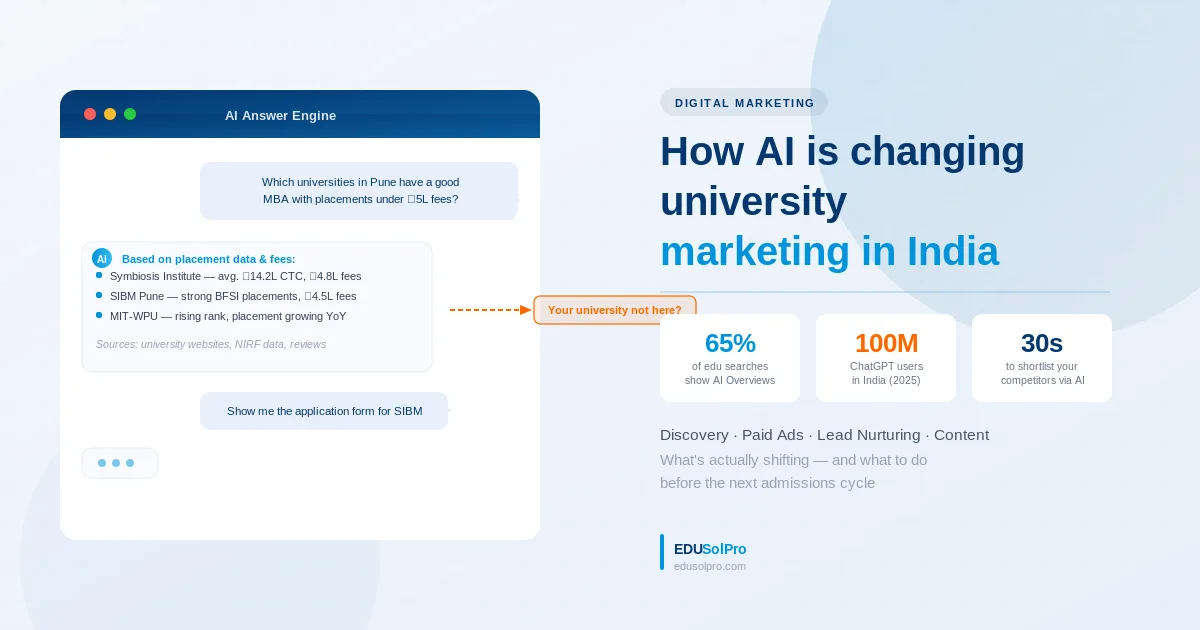
The same student today opens ChatGPT, types “which universities in Pune have a good MBA with strong placement records under 5 lakh fees,” and gets a synthesised answer with specific names and reasons in thirty seconds. They may never reach your Google ranking at all.
Most university marketing teams are still building their strategy around the first student. That’s a problem because the second student is already making decisions.
Where the actual changes are
1. How students find universities
AI answer engines (Google AI Overviews, ChatGPT, Perplexity) are increasingly where students build their shortlist. These systems don’t rank websites the way Google’s traditional algorithm does. They pull from content that is structured, specific, and directly answers the questions students ask.
A university with solid Wikipedia coverage, detailed FAQ content on programme pages, and actual placement and fee data written in plain language will show up in AI-generated answers. A university with impressive design and vague copy won’t. The difference is not budget or brand recognition. It’s whether the content was written for a student asking a direct question, or for a brochure committee that approved it three years ago.
That’s what makes answer engine optimisation worth taking seriously now. If your institution gets cited in a student’s ChatGPT answer, you’ve already cleared the first hurdle before a single ad has run or a call has been made.
2. Paid advertising
Google and Meta have both moved their ad products heavily toward AI-managed campaigns. Google’s Performance Max allocates budget across Search, Display, YouTube, Gmail, and Discover. Meta’s Advantage+ does the same across Facebook and Instagram.
Real-time bid adjustments, audience signal matching, cross-channel budget shifts. The processing speed is genuinely beyond what any human campaign manager can replicate manually.
Campaign strategy, programme-level messaging, landing page quality, and deciding which conversion signals the algorithm should actually optimise for. The AI amplifies what you feed it.
The universities getting the best cost-per-lead from Google and Meta right now are not the ones fighting the algorithm. They’re giving it better inputs: cleaner conversion tracking, programme-specific landing pages, stronger creative. If your account sends Performance Max to a generic homepage with no conversion pixel, the algorithm has nothing useful to learn from. It will spend your budget on the easiest traffic rather than the most valuable.
3. Lead nurturing and automation
This is where most admissions funnels quietly collapse. Student submits a form. The calling team calls twice. No answer. The lead sits cold and nobody follows up systematically.
AI-enabled marketing automation tools can run personalised sequences (WhatsApp messages, emails, retargeting ads) triggered by what the student actually does, without someone manually managing each interaction. A student who opens the brochure PDF but doesn’t reply gets a different follow-up to one who hasn’t opened anything. One who visits the fees page again three days later gets flagged as high intent for the calling team.
The catch is that it requires clean data and integrated systems upfront. Universities that try to automate a broken CRM process just automate the chaos. Setting this up properly (mapping the student journey, connecting the CRM to the ad platforms, defining the trigger logic) is where most teams stall.
4. Content and SEO
AI tools have produced a flood of generic content across every industry. The side effect: specific, original, data-backed content now stands out more, not less. Google’s quality signals have adjusted accordingly, and the gap between institutions publishing real data versus those publishing AI-generated descriptions is getting wider.
The programme pages and blog posts ranking well in 2026 are not the ones produced fastest. They’re the ones with real placement figures, honest fee comparisons, specific faculty credentials, and student outcomes that can’t be generated from a prompt. An AI tool can write quickly. It cannot make up your university’s actual track record.
Use AI to draft structures, research faster, and handle repetitive work, but treat it as a starting point. The content marketing work that produces sustainable organic traffic is the kind that adds what only your institution has: specific numbers, verified outcomes, and a perspective shaped by actual experience working with students.
5. Student-facing communication on your website
This gets less attention than it deserves. AI tools are now good enough to power genuinely useful chat experiences on university websites (answering fee queries, explaining admission requirements, pointing students to the right programme page) at 11pm when no one from the admissions office is available.
Universities deploying this well are not running generic chatbots that say “I didn’t understand your query, please call us.” They’re running tools trained on their actual programme data, fees, hostel information, and eligibility criteria. A student who gets a useful answer at 11pm on a Sunday is more likely to submit an inquiry than one who hits a dead end and closes the tab.
The bar is low here because most university websites still have no chat layer at all. Getting something useful in place before the next admissions season is a weeks-long project, not a months-long one.
What actually needs to happen
There’s no version of this that doesn’t require some groundwork. The universities pulling ahead are making their programme content specific enough for AI systems to cite, giving their paid campaign algorithms clean data to work with, building nurture sequences that follow students beyond the first call, and making sure their website can answer a question at any hour.
None of it needs an enormous budget. It needs someone with a clear view of the admissions funnel and the authority to connect the pieces. Once that’s in place, your marketing budget does considerably more than it did before.
The admissions teams that sort this out over the next two cycles will pull ahead of those that don’t. That gap tends to be hard to close once it opens.
Related reading: