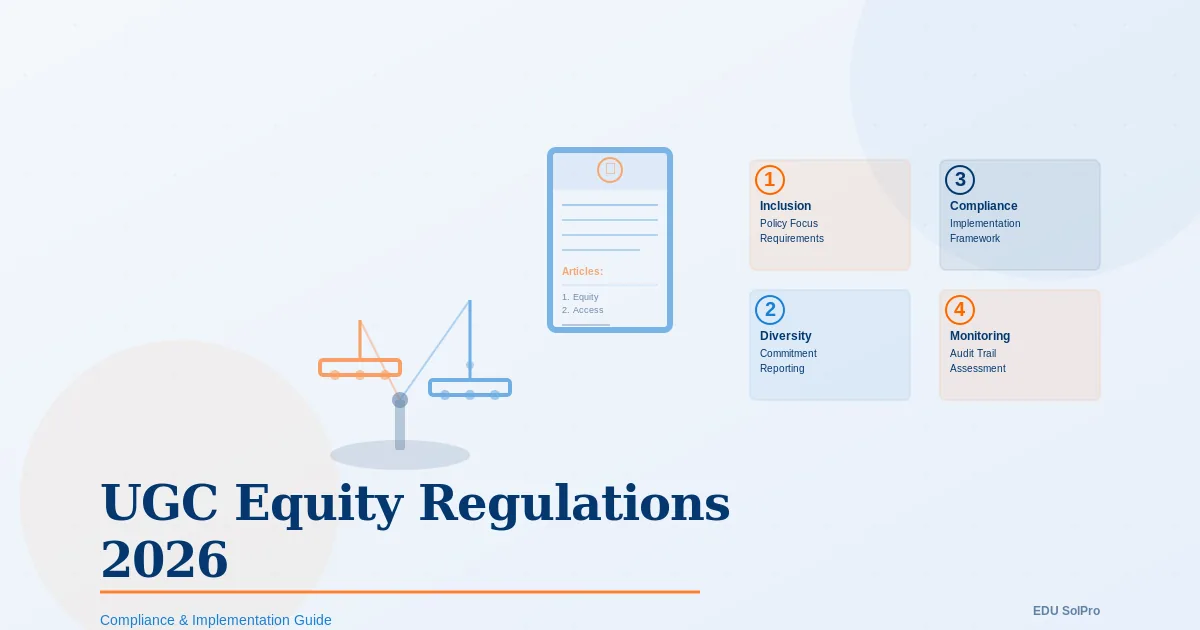
On January 13, 2026, the University Grants Commission notified the Promotion of Equity in Higher Education Institutions Regulations, 2026. If you’re a VC or Registrar, this matters. These UGC equity regulations 2026 establish a compliance framework that touches admissions, student support, marketing, and institutional accountability. While the Supreme Court stayed the regulations on January 29, 2026, institutions should treat this as regulatory direction and prepare for full implementation when the stay lifts. For official regulatory text and updates, visit www.ugc.gov.in. Here’s what you need to know about the regulations, the timeline, and how they reshape your admissions marketing.
What the UGC equity regulations 2026 actually require
The regulations define discrimination broadly: any direct or indirect, explicit or implicit unfair treatment based on caste, religion, gender, race, place of birth, or disability. For most universities, this translates to five concrete obligations.
First, an Equity Committee. Your institution must establish a committee chaired by the head of the institution (VC or Principal). The committee includes senior faculty, non-teaching staff, civil society representatives, and student members from SC, ST, OBC, persons with disability, and women backgrounds. The committee meets at least twice a year, investigates complaints within 24 hours for severe cases and 15 working days for standard complaints, and recommends corrective action.
Second, an Equal Opportunity Centre. Larger institutions must maintain a dedicated EOC to promote diversity, offer academic and financial counselling, connect students with legal aid, and coordinate with external agencies like NGOs and police. Institutions with fewer than 5 faculty defer to their affiliating university’s EOC.
Third, an Ombudsperson. If a student or staff member feels the Equity Committee hasn’t resolved their complaint adequately, they can escalate to an Ombudsperson. This creates a two-tier grievance system.
Fourth, data collection and transparency. The regulations require institutions to track and report on student demographic composition, particularly SC/ST/OBC/EWS/PwD enrollment, retention, and outcomes. You cannot hide behind aggregate numbers anymore.
Fifth, anti-discrimination policies. Explicit written policies must cover hostel access, scholarships, course access, and disciplinary processes. The policies must be communicated to all stakeholders, not filed in a cabinet.
The head of the institution is held directly responsible for implementation. Non-compliance carries teeth: UGC can debar your institution from UGC schemes, restrict you from offering degrees through distance or online modes, or withdraw recognition entirely.
How UGC equity regulations affect your admissions marketing
Most universities assume compliance is an internal HR and student services function. They miss the marketing angle. The regulations reshape what you can and cannot say in your admissions communications, and they create legitimate marketing assets.
What you cannot say. Your admissions ads cannot explicitly target or exclude based on caste, religion, or gender. A WhatsApp campaign saying “We actively recruit SC/ST students” reads as inclusion; the same message with imagery of only SC/ST faces might be seen as ghettoizing. Scholarship advertisements must emphasize openness to all categories. You cannot market programs with statements like “Traditional families preferred” or “Religious background preferred.”
What you must say. Your website and marketing collateral must transparently communicate your scholarship categories, reservation system, disability accommodations, and grievance mechanisms. If your institution offers 100 seats and 25 are reserved for SC/ST, this should be stated clearly in program marketing. If you have a scholarship for first-generation students, promote it. If you offer accessible infrastructure, show it.
Why this is a marketing asset. First-generation students and students from marginalized backgrounds actively search for signals of institutional fairness. They check Google reviews, Quora, Shiksha.com, and campus posts. An institution that communicates equity measures — dedicated OBC mentorship, hostel accessibility, education loans for EWS students — attracts applications from this segment. These students are often ignored by institutions that only emphasize rankings or infrastructure.
Regional and non-top-50 universities have found that diversity-forward messaging attracts more applications than prestige-only messaging. A regional engineering college with an EWS mentorship program will recruit better from EWS families than one that ignores equity.
Compliance timeline: what UGC expects by when
The regulations were notified on January 13, 2026. The Supreme Court stayed implementation on January 29. Once the stay is lifted (timeline uncertain), universities will have approximately 4-6 months to establish Equity Committees and EOCs, draft policies, and train staff.
For prudent institutions, the timeline is now. Form your Equity Committee immediately, even in draft form. Audit your current admissions language against the regulation’s definition of discrimination. Ensure your website explicitly states reservation categories, scholarship eligibility, and disability support. Brief your admissions team that vague language or evasiveness will not survive scrutiny.
Risks of non-compliance
NAAC accreditation. NAAC assessors now explicitly evaluate equity and inclusion. An Equity Committee that exists only on paper will be flagged. NAAC scores have begun declining for institutions with weak diversity indicators.
UGC recognition. The regulations carry enforcement teeth. UGC can impose conditions on recognition.
Reputational damage. Student reviews mentioning discrimination, even anecdotal, spread faster on Google and social media than your marketing budget can contain. An institution without visible equity infrastructure becomes a cautionary tale.
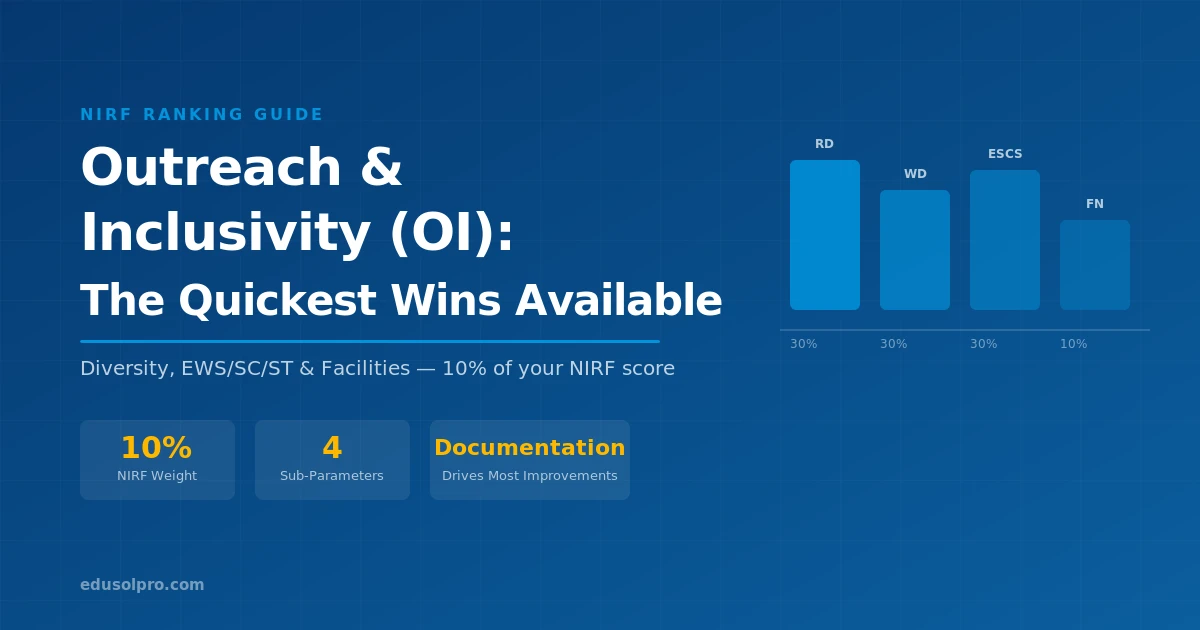
Rankings. NIRF’s research and innovation category and teaching quality category now factor in diversity indicators. Poor diversity metrics lower your overall score.
Practical steps to get compliant this month
Audit your current admissions materials. Print your website’s admissions section, your brochures, and your last three WhatsApp campaigns for your admissions team. Highlight any language that explicitly or implicitly references caste, religion, gender, or class. Revise it.
Draft your Equity Committee charter. Write a one-page charter that names the chair (VC/Principal), identifies committee members by role (not name), and sets meeting frequency. Have the VC endorse it.
Audit your scholarships. List every scholarship. Note eligibility criteria. If criteria are vague (“merit-based”) or tied to background (“from good families”), revise them to be explicit and non-discriminatory.
Brief your admissions team. An hour-long training session covering the regulations and what language is acceptable costs nothing and prevents dozens of compliance errors.
Create a grievance log. Even if you have no current grievances, set up a simple spreadsheet to track any complaints related to discrimination, exclusion, or unfair treatment. This signals that you take the regulation seriously.
The regulations change how universities market themselves in India. The shift from prestige-only messaging to a blend of prestige and equity is already underway. Universities that communicate equity clearly — mentorship programs, accessible infrastructure, dedicated support — see clearer recruitment conversations and enrollment from underrepresented groups.
This is not just compliance. It’s good business — and it connects directly to how to increase student enrolment through underrepresented segments that most universities ignore.
Key Takeaways
- The UGC equity regulations 2026 mandate Equity Committees, Equal Opportunity Centres, Ombudsperson roles, and transparent demographic tracking.
- Your Equity Committee chair is the head of the institution; non-compliance can trigger loss of UGC recognition or distance/online program restrictions.
- Admissions marketing must transparently communicate reservation categories, scholarships, and accommodation policies.
- Institutions that proactively market equity measures (mentorship programs, EWS support, accessibility) attract higher-intent applications from first-generation and underrepresented students.
- Non-compliance affects NAAC scores, NIRF rankings, and reputational standing.
Next Steps
The regulations reshape admissions messaging. If your institution’s marketing has been equity-silent, start now. Audit your current admissions language, brief your teams, and align marketing with compliance. The cost of compliance is low; the cost of reputational damage is high.
Ready to align your admissions marketing with UGC equity regulations? Our digital marketing services help universities audit messaging, improve website clarity, and strengthen lead generation from underrepresented student segments. Schedule a consultation.
For broader digital strategy guidance, see our articles on digital marketing for universities.