The Outreach and Inclusivity (OI) parameter carries 10% of your NIRF score, the lowest weight among the five parameters, shared with Perception. Despite its weight, OI is often where institutions make preventable errors. They either misunderstand what NIRF is counting or have the actual performance but lack documentation to substantiate it.
This guide covers how OI is calculated, the specific documentation NIRF requires for each sub-parameter, and which improvements are genuinely achievable in your next cycle.
For official NIRF methodology, visit www.nirfindia.org.
What OI measures
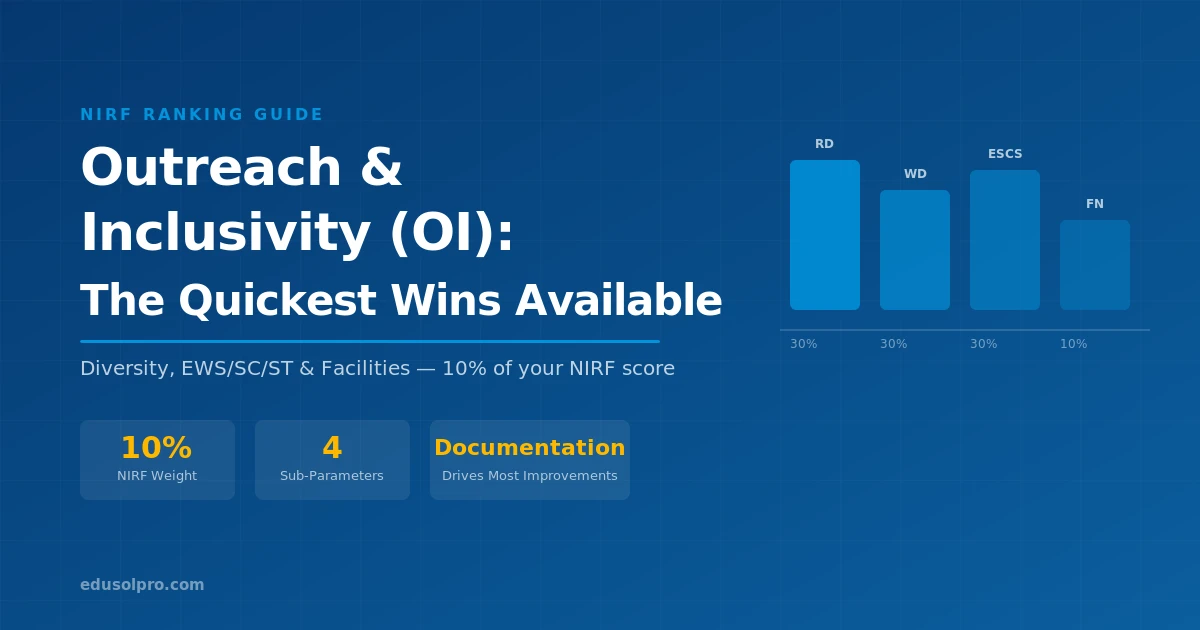
OI has four sub-parameters:
The first thing to notice: RD, WD, and ESCS each carry 30% of the OI score. Facilities for the physically challenged carry 10%. All four are worth addressing, but the three 30% sub-parameters are where the meaningful marks are.
Regional Diversity: legitimately the hardest to move quickly
Regional Diversity (RD) measures the percentage of your enrolled students who come from states other than where your institution is located. A Gujarati university with 95% Gujarati students scores poorly here, regardless of its academic quality.
This is genuinely hard to improve fast. Geographic diversity depends on your institution’s reputation, programme appeal, hostel capacity, and marketing reach, all of which take years to build.
What you can do in the short term:
- Ensure you’re counting every eligible out-of-state student correctly. Students who list a home state address are counted as out-of-state even if they’ve lived locally for years. Make sure your admission forms capture permanent home state, not current residence.
- If you run distance or online programmes, students enrolled from other states through these programmes may count — verify this with the current NIRF methodology for your category.
- Targeted state-specific digital marketing for your highest-demand programmes can attract out-of-state applications at a lower cost than generic campaigns. Our student recruitment strategies guide covers how to approach geographic targeting in paid campaigns.
The honest answer: institutions in tier-1 cities or with nationally recognised programmes naturally score better on RD. If you’re a strong regional institution, set a realistic improvement target (1–3 percentage points per cycle) rather than expecting to close the gap with IITs or NITs in a year.
Women Diversity: usually better than you’re reporting
Women Diversity (WD) measures the proportion of women in your total enrolled strength. For many institutions, the real performance is better than what gets submitted to NIRF because women students in non-traditional programmes or lateral entry are sometimes counted incorrectly.
For programmes with naturally lower women enrolment (certain engineering branches, some law specialisations), WD is hard to influence in the short term. In those cases, make sure you’re not making it worse through inaccurate counting, and consider whether your marketing and scholarship communications are genuinely outreach-oriented or whether they’re implicitly targeting one gender.
EWS/SC/ST/OBC data: documentation is everything
The Economically and Socially Challenged Students (ESCS) sub-parameter is where most institutions leave marks, and where documentation problems are most common.
NIRF looks at two things: the actual enrolment numbers for EWS, SC, ST, and OBC students, and the support mechanisms in place (scholarships, fee waivers, remedial coaching, hostel reservations).
What NIRF requires for ESCS documentation:
- Category-wise enrolment data cross-referenced with admission records
- Evidence of scholarship disbursal: beneficiary lists, bank transfer records, or award letters
- Fee concession records with amounts per student
- Hostel reservation data if applicable
The most common error: institutions apply reservations correctly in admissions but don’t maintain the documentation trail that proves it. When NIRF asks for evidence of “support mechanisms,” the answer can’t be just a policy document. It needs to show actual disbursal.
One thing NIRF does look at: your scholarship amounts and what percentage of eligible students received them. If your EWS enrolment is high but scholarship disbursals are low, the ESCS score reflects that gap.
Facilities for physically challenged: ramps alone aren’t enough
The Facilities for Physically Challenged (FN) sub-parameter carries only 10% of OI, but it’s where many institutions score close to zero when they should be scoring much higher.
The common assumption: ramps and a few modified classrooms are sufficient. NIRF’s assessment is broader.
What NIRF counts under FN:
- Physical infrastructure: ramps, elevators, accessible toilets, tactile flooring, hearing loops
- Academic accommodations: scribes for exams, extra time allowances, screen reader access in digital resources
- Administrative accommodations: reserved seating at admission counters, accessible grievance processes
- Staff awareness: documented training for faculty on reasonable adjustments
Many institutions have some of these in place but have never formally documented them or mapped them to the DCS fields. A day spent with the facilities manager and examination controller, listing everything that already exists, often reveals the institution’s actual provision is significantly better than what was submitted.
One genuine gap that affects many institutions is digital accessibility. If your LMS or e-learning resources aren’t compatible with screen readers and your library’s e-databases don’t have accessibility modes, this is both a real gap and documentable. Most major vendors (JSTOR, Springer, Wiley) have accessibility compliance statements that can be referenced in your DCS submission.
FAQs
Do international students help or hurt the RD score? International students are typically counted separately and may actually improve your RD score, depending on how NIRF categorises them in your institution’s category. Check the current methodology for your specific NIRF category (University, Engineering, College, etc.) as the treatment can differ.
We have a high proportion of EWS students but our ESCS score is still low. Why? ESCS doesn’t only count enrolment — it also scores support mechanisms. High enrolment without documented scholarship disbursal, fee waiver evidence, or remedial support programmes will produce a lower score than the enrolment numbers suggest. Check whether your support evidence matches the enrolment data in your DCS.
Can we improve WD by adding women-specific scholarships mid-year? Scholarships introduced mid-year won’t change your WD score (which is based on enrolment proportions, not scholarships). However, women-specific scholarships improve your ESCS score if disbursed correctly — and they may attract more women applicants in the next admissions cycle, improving WD over time.
Does a disability cell on campus automatically count for FN? Having a disability cell is one component, but NIRF looks for evidence that the cell is functional — student grievances handled, accommodation letters issued, exam adjustments documented. A cell that exists on paper without evidence of activity doesn’t contribute meaningfully to the FN score.
Is OI data verified by NIRF or self-reported? Data is primarily self-reported through the DCS, but NIRF does conduct document verification for a sample of institutions each cycle. The verification focuses on the documentary evidence behind each claim. Inflated or unsupported data is the main risk — always submit with supporting documentation ready.
OI won’t move your rank by itself, but leaving 10% of your score under-documented is avoidable. The ESCS and FN sub-parameters are areas where better documentation of existing performance translates directly into better scores in the next cycle.
For all five NIRF parameters: