Indian universities are facing a real enrollment challenge. Demographic pressures in some states have compressed the pool of school leavers. Deemed universities have multiplied competition. Online degrees from established institutions now pull students who once applied locally. And parents’ perceptions of what a “good college” is have fragmented: some chase NIRF rank, others value infrastructure, many just want value for money. Against this backdrop, traditional admissions, a marketing head sending a brochure to a school principal, is dead.
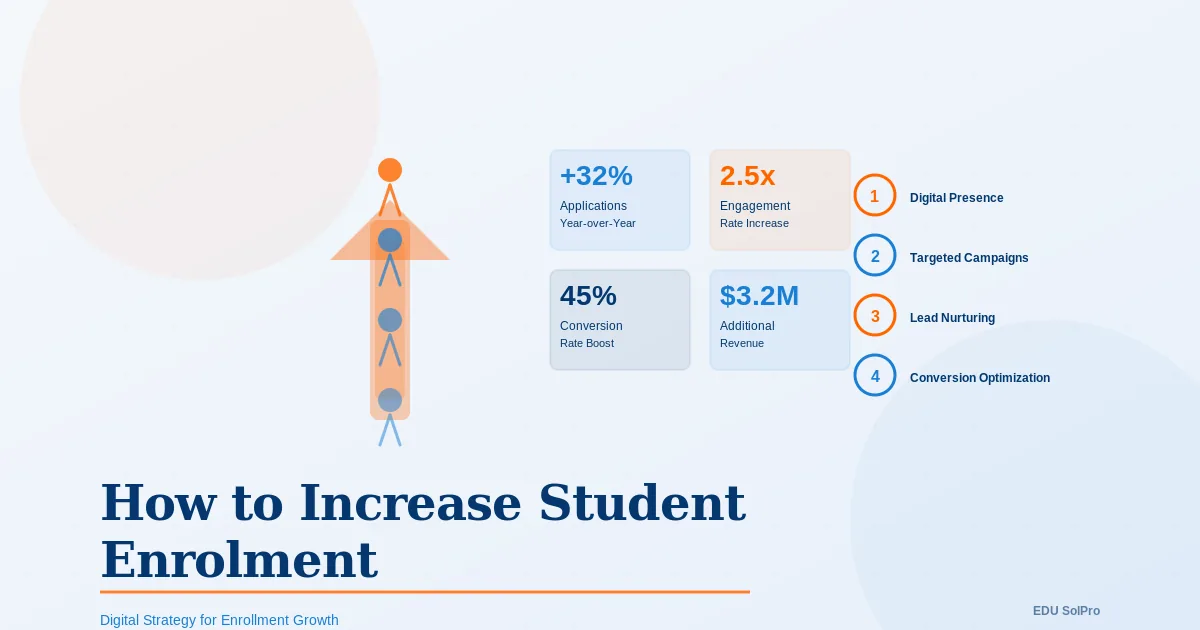
How to increase student enrolment requires a digital strategy. Not just a website redesign or a Facebook page, but a deliberate system that builds awareness, drives inquiry, nurtures leads, converts them to applications, and supports enrollment completion. This guide shows you how. Start by understanding the full scope of digital marketing for universities, then apply the tactical six-lever framework below to your specific situation.
Why Indian universities are losing enrollment
Before tactics, understand the headwind. Three forces are at play.
Demographic decline in some regions. States like Punjab, Himachal Pradesh, and parts of Karnataka have seen a drop in school-leaving age population. The National Education Policy aims to raise Gross Enrollment Ratio (GER) to 50% by 2035, but that requires new entrants to replace those opting out. In low-growth regions, that trade is difficult.
Rise of online and blended degrees. An engineering student in a Tier 2 city can now enroll in IIT Bombay’s NPTEL-based degree or Manipal’s online B.Tech. Distance learning is no longer a stigma. This competition is new and structural; it won’t reverse.
Consolidation of perception. Students increasingly research college options online. They read Google reviews, check Quora threads about campus life, watch YouTube walkarounds, and compare NIRF rankings. Perception is hyperlocal and transparent. A college with a low rating on Google and no social media presence loses applicants regardless of how good the teaching actually is.
The solution is not to become defensive. It’s to recognize that students now shop like consumers. Your job is to be visible where they search, credible where they decide, and convenient when they apply.
The 6-lever digital enrolment framework
Think of enrollment as a funnel with six stages. Each stage has different channels, metrics, and success criteria.
Lever 1: Awareness. Your target students and their parents don’t yet know your institution exists or know it only vaguely. Google Ads, YouTube pre-roll, regional-language content, and Instagram organic reach are your tools here. Metrics: impressions, video views, reach.
Lever 2: Consideration. They now know you exist and are actively considering you. Content answering their questions — “How good is your faculty?”, “What’s the placement outcome?”, “What’s the fees?” — moves them here. Metrics: click-through rate, time on website, pages per session.
Lever 3: Inquiry. They’ve decided to engage. They fill a “Request Information” form, call the admissions number, or message you on WhatsApp. Metrics: cost per inquiry, form conversion rate, response time.
Lever 4: Application. They’ve submitted a formal application. Metrics: application volume, application completion rate (many students begin and abandon).
Lever 5: Enrollment. They’ve been offered admission and have confirmed their enrollment. Metrics: offer-to-enrollment ratio, confirmation rate.
Lever 6: Anti-melt. They’ve confirmed but may change their mind before semester starts. A competing institution offers a scholarship, or parental doubts creep in. Metrics: confirmation-to-actual-enrollment ratio.
Most universities ignore Levers 5 and 6. They assume that an admission offer means enrollment is guaranteed. It’s not. A student who has confirmed enrollment but hasn’t paid fees can still enroll elsewhere.
Digital tactics for each lever
Awareness: where students first hear about you
Google Ads for program-specific terms. Run search campaigns on high-intent keywords. Examples: “B.Tech Computer Science colleges in Bangalore,” “MBA colleges near Mumbai,” “BCA colleges in Kolkata.” Cost per click is lower for these specific terms than for brand searches. Monthly search volume for “B.Tech colleges in India” is roughly 1.5 lakh; “MBA colleges near Pune” is 40K. Start with the latter, lower volume, higher intent.
YouTube awareness campaigns. Create 15-second skippable ads showing campus life, student testimonials, and faculty expertise. Target by location (state, city) and age (16-30). YouTube CPM in education is roughly 100-300 rupees; a ₹50K monthly budget reaches 200K-500K students.
Regional-language content. If your institution is in a Hindi or Tamil or Telugu medium area, content in that language will outrank English content for local students. A YouTube video titled “BBA colleges near Coimbatore” will reach fewer students than “Coimbatore-la nalla BBA colleges” (in Tamil). This is not optional for Tier 2/3 cities.
Instagram organic. Post campus photos, student testimonials, behind-the-scenes videos. Hashtags like #EngineeringLife, #CollegeDays, #PlacementSeason drive organic reach. An average college Instagram post reaches 5-15% of followers; with 10K followers, that’s 500-1500 impressions per post. Frequency matters: post 4-5 times a week.
Search engine optimization. Ensure your website ranks for your program pages. A student searching “Computer Science engineering colleges in Bangalore” should find your college on page 1 of Google. SEO takes 3-6 months to show results, so start now.
Consideration: turning awareness into serious interest
Detailed program pages. Your website’s Computer Science page should answer: What is the curriculum? Who are the faculty? What are placements? What is the fees? What is the hostel situation? Add testimonials from Computer Science alumni. Update this page every semester; stale content tanks rankings.
Blog articles on decision criteria. Write articles like “How to choose between B.Tech and B.Sc in Computer Science,” “What to expect from a BBA program,” “Top 5 factors in choosing an engineering college.” These articles rank for consideration-stage keywords and help students make decisions.
Placement data transparency. If your average placement package is ₹8 LPA, state it. If 85% of graduates are placed within 3 months, state it. If you don’t have this data, start collecting it. Students and parents will trust you more if you volunteer numbers than if you evade.
Campus walkthrough videos. A 5-minute video showing the library, lab, hostel, cafeteria, and classroom is worth 50 pages of text. Shoot on a smartphone, keep it real, and upload to YouTube and your website.
Inquiry: converting consideration into action
Lead magnet. Offer a downloadable PDF: “Complete Guide to B.Tech Admissions in India” or “MBA Program Comparison Checklist.” A well-structured PDF will convert 10-20% of website visitors who see it into leads.
WhatsApp campaigns. Once you have a student’s phone number, don’t just send emails. Send WhatsApp messages. WhatsApp open rate is 98% compared to email’s 20-30%. Your message: “Hi [Name], Thanks for your interest in our B.Tech program. Your counselor, Priya, will call you tomorrow at 4 PM. Any questions? Reply here.”
Inquiry form simplicity. Your “Contact Us” form should ask for three things: name, phone, program of interest. Not a 20-field form. You can ask for email, address, 10th mark percentage later. First, get the phone number.
24-hour response guarantee. If an inquiry comes in at 11 PM, send a WhatsApp acknowledgment within 30 minutes and schedule a phone call within 24 hours. Most universities let inquiries sit for days, losing momentum.
Live chat on website. A visitor browsing your Computer Science page at 10 PM should be able to click a chat button and ask a question. If you can’t staff this 24/7, a chatbot that collects the visitor’s name and query, then routes it to your team, is better than nothing.
Application: removing friction from the process
Online application portal. Students should be able to apply in 10 minutes from a smartphone. No PDFs to fill, no documents to scan. Upload your 12th marks photo, your address, your category (SC/ST/OBC/EWS if applicable), and submit.
Multi-payment options. Accept not just bank transfers but also card, UPI, and NEFT. Some students don’t have credit cards. Some parents want to pay via NEFT from out of state. Make it frictionless.
SMS + WhatsApp confirmations. After application submission: SMS confirmation, WhatsApp confirmation, email confirmation. The student should have no doubt that their application was received.
Application status tracker. The student should log into the portal anytime and see: “Your application is under review. Expected decision by April 15.” Uncertainty kills the funnel; transparency builds confidence.
Enrollment and anti-melt: the forgotten half
Offer letter clarity. The day a student is admitted, send a formal offer letter listing: program, fees, hostel cost, scholarship amount if any, and confirmation deadline. Make it unmissable.
Enrollment contingency planning. Flag students who haven’t confirmed 14 days after the offer. Call them. Are they waiting for scholarship confirmation? Do they have doubts about the program? Resolve it now.
Comparative scholarship strategy. If a competing institution offers a scholarship, be willing to match or exceed it for high-performing or first-generation students. The cost of a ₹1L scholarship is less than the cost of running an underutilized batch.
Hostel and placement assurances. Once a student confirms, send a hostel assignment letter if applicable. Share a list of top placements from previous batches. Reduce uncertainty.
Reverse-engineering your enrollment target into a marketing budget
Here’s how to set a realistic marketing budget. Work backward.
Assume your target is 500 enrolled students. Assume your offer-to-enrollment conversion is 80% (reasonable for most institutions). You need 625 offers.
Assume your application-to-offer conversion is 40% (decent). You need 1,562 applications.
Assume your inquiry-to-application conversion is 60%. You need 2,603 inquiries.
Assume your website visit-to-inquiry conversion is 5%. You need 52,060 website visitors.
Now, what does it cost to drive 52K visitors? If your average cost per click from Google Ads is ₹15 and you need 52K clicks, your ad spend is ₹7.8 lakhs. Add organic (SEO, YouTube, social) to reach another 30K visitors for free or low cost, and your total digital spend is roughly ₹8-10 lakhs to hit your 500-enrollment target. For a more detailed breakdown of how to allocate your full marketing budget by channel, read the university marketing budget guide for 2026.
Cost per enrolled student: ₹16,000-20,000.
This is not a number you pull from air. It’s a framework. Your conversion rates may be different. Your geography may change your cost per click. But working backward ensures that your budget aligns with your target.
The role of NIRF ranking in enrollment
NIRF ranking matters for brand awareness and consideration. Students in Tier 1 cities often check rankings. Parents in Tier 2/3 cities care less, but still ask: “Did you see the ranking?”
If your institution is not in the top 100, do not despair. Highlight other signals: “Ranked #15 in India for Computer Science by [specific ranking body],” “85% placement rate,” “Average package ₹9 LPA.” Be specific. Avoid vague claims like “top-tier infrastructure.”
For institutions inside the top 100, lean hard on the ranking in marketing. It’s your most powerful differentiator.
Quick wins you can implement this month
-
Audit your Google My Business profile. Ensure your address, phone, website, and hours are correct. Add photos of campus. Students often call a college using the phone number on Google Maps; if it’s wrong, you lose an inquiry.
-
Launch a simple Google Ads campaign. Start with a ₹20K budget targeting three high-intent keywords. Measure cost per inquiry. Adjust.
-
Post one campus tour video to YouTube. Even a shaky smartphone video is better than nothing. Optimize the title: “[Program Name] College Tour | Campus Life | Admissions [Year].”
-
Create a 3-question inquiry form. Name, phone, program. Nothing else. Place it on every program page.
-
Set up WhatsApp Business. Connect it to your CRM. Anytime an inquiry comes in, automatically send a WhatsApp welcome message.
-
Brief your admissions team on response times. Agree that every inquiry gets a WhatsApp within 30 minutes and a phone call within 24 hours.
These six actions will improve your inquiry volume and conversion rate within 30 days.
Key Takeaways
- How to increase student enrolment depends on a 6-lever framework: awareness, consideration, inquiry, application, enrollment, and anti-melt.
- Each lever requires different channels and metrics. Most universities excel at one or two levers and ignore the rest.
- Digital channels now drive 62% of student enrollments in India. Google Ads, YouTube, WhatsApp, and regional-language content are non-negotiable.
- Work backward from your enrollment target to set a realistic marketing budget.
- NIRF ranking matters for brand positioning, but placement, faculty, and accessibility matter more for actual enrollment decisions.
- Anti-melt, keeping confirmed students enrolled, is as important as acquisition.
Next Steps
If your current digital strategy feels scattered or underperforming, you likely have gaps in one or more of these six levers. Many universities run Google Ads but don’t have a lead nurturing process. Others have strong awareness but a terrible application portal.
An audit of your current enrollment funnel will identify where you’re leaking students. EDU SolPro’s digital marketing services include enrollment funnel audits, lead generation setup, and conversion rate optimization. We work with VCs and Registrars to build systems that work.
For deeper guidance on other aspects, read education lead generation and how to improve NIRF ranking.