You’re a Registrar or Marketing Head at a mid-tier Indian university. Your enrollment has been flat for two years. Your website is outdated. You’re getting outbid on search ads by larger institutions. Someone suggests hiring a digital marketing agency. So you call three agencies, they all promise rankings and leads, and suddenly you’re wondering what you actually just agreed to.
Generalist agencies fail in higher education because they don’t understand the sector. They think university marketing is like selling shoes. It’s not. Universities have a 6-9 month enrollment decision cycle, multiple stakeholders (student, parent, school counselor, admission office), regulatory constraints on claims you can make, and a completely different sales funnel than B2B SaaS or ecommerce. For a comprehensive understanding of what effective digital marketing for universities looks like, read our complete guide to digital marketing for universities before evaluating agencies.
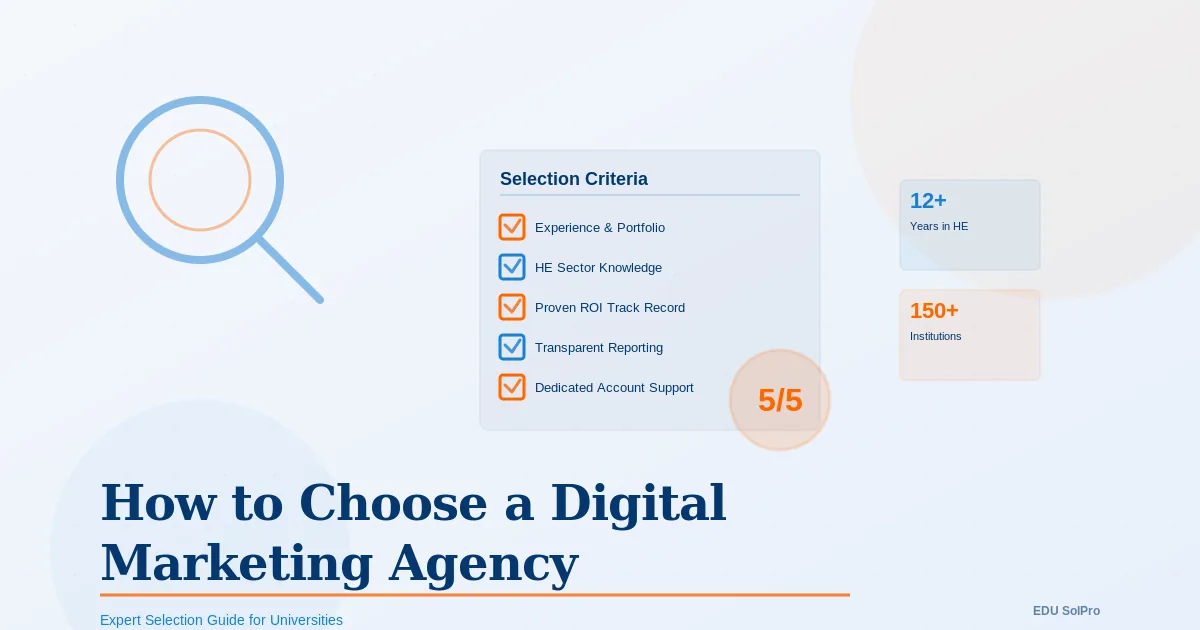
This article gives you eight specific questions to ask any digital marketing agency before you sign a contract. It’s designed for VCs, Registrars, and Marketing Heads. Use this as your checklist.
Question 1: Can you explain NIRF and its link to your digital strategy?
NIRF (National Institutional Ranking Framework) rankings drive enrollment. Parents ask, “What’s the university’s NIRF rank?” before anything else. A strong digital strategy explicitly connects enrollment marketing to NIRF improvement.
Ask the agency:
“How do NIRF rankings influence your content strategy? How would you optimize our web presence to show our research output, industry partnerships, and placement stats, which are the factors NIRF measures?”
Listen for:
- Mention of NIRF parameters: Research, Teaching, Perception, Employability, Inclusivity
- Understanding that web visibility for research papers, faculty profiles, and placement outcomes influences NIRF rankings
- Strategy for making your research and facilities visible to NIRF evaluators via your website and press coverage
- Specific tactics like publishing case studies on faculty research, displaying industry partnerships, and creating dedicated pages for placement outcomes
Red flag: The agency has never heard of NIRF or thinks it’s irrelevant to digital strategy. NIRF rankings are a primary driver of institutional credibility. Any agency working in Indian higher education without understanding this isn’t competent for the sector.
Question 2: Do you have case studies with specific enrollment metrics from education clients?
Generalist agencies will show you a case study where they got 40% more traffic to a website. Education agencies will show you increased enrollment applications or confirmed enrollments.
Ask the agency:
“Show me a case study where you worked with a university similar to ours (by program type and size). What were the starting point metrics? What were your enrollment-focused KPIs, and what did you achieve?”
Listen for:
- Specific metrics: cost per inquiry, cost per application, inquiry-to-enrollment conversion rate
- Before/after comparison (e.g., 200 inquiries/month to 450 inquiries/month; conversion from 8% to 15%)
- Time frame (it took 6 months to see results, not 6 weeks)
- Explanation of what channels and strategies drove the improvement
- Honest challenges they faced and how they solved them
Red flag: The agency shows traffic metrics only (“We increased organic traffic by 120%”). Traffic is meaningless if it doesn’t convert to inquiries or enrollments. If they can’t produce enrollment-focused case studies from education clients, they’re likely working in education for the first time.
Question 3: How do you handle the 6-9 month admissions cycle?
University enrollment is not a quick decision. A student starts researching in July, talks to multiple universities through September-October, applies in November-December, gets an offer in February-March, and confirms enrollment in April-May. Your digital strategy must account for this slow, deliberate process.
Ask the agency:
“How do you adjust your strategy for the long enrollment cycle? Do you have nurture sequences? How do you prevent leads from going cold? What’s your approach to staying in touch with a prospect who’s comparing us to three other universities?”
Listen for:
- Mention of lead nurturing sequences, email/WhatsApp campaigns timed to the enrollment calendar
- Segmentation by program type (UG vs. PG have different cycles)
- Understanding of seasonal demand (peak inquiry season July-October, peak enrollment April-June)
- Remarketing strategy to keep your university top-of-mind during a student’s 6-9 month decision window
- Integration with CRM or admission management system for lead tracking
Red flag: The agency talks about driving traffic and conversions within 30-60 days. That’s ecommerce thinking, not education thinking. If they don’t understand that enrollment is a marathon, not a sprint, they’ll burn budget chasing fast conversions that don’t materialize.
Question 4: What’s your approach to regulatory constraints on education advertising?
You cannot make unsubstantiated claims about placements (“100% placement guarantee”). You cannot make unauthorized claims about accreditations. You must disclose fee structures clearly. There are state-level regulations on what you can advertise in which languages and to which age groups.
Ask the agency:
“How do you ensure our ads and website copy comply with education advertising regulations in India? Have you worked with other universities to navigate these constraints?”
Listen for:
- Awareness of UGC regulations, state education board rules, and platform advertising policies (Google, Meta)
- Questions about your accreditations, fee structure, and placement claims
- Process for reviewing creative assets for compliance before launch
- Examples of how they’ve helped other universities word claims accurately without overpromising
Red flag: The agency dismisses regulatory concerns or guarantees they can get around restrictions. Violating advertising regulations can result in fines, your ads getting disapproved by platforms, and damage to your institution’s reputation. Any agency that doesn’t take this seriously is a liability.
Question 5: How do you track full-funnel enrollment data?
Many agencies stop tracking after a lead inquiry. You care about conversions through to enrollment. An agency that doesn’t have a system to track inquiry → application → offer → enrollment is flying blind.
Ask the agency:
“Walk me through how you’ll track a prospect from first visit to confirmed enrollment. What data points do you measure? How often will we see funnel reports? How will you know if someone got an offer but didn’t enroll, and why they dropped?”
Listen for:
- UTM parameter and pixel implementation to track full funnel
- Integration with your CRM or admission system to see the complete student journey
- Monthly reporting showing inquiries, applications, offers, and enrollments by source
- Analysis of drop-off points (where do leads go cold?) and optimization recommendations
- Ability to attribute enrollment to specific campaigns and channels
Red flag: They talk about leads but not conversions. They can’t explain how they’ll get data from your admissions team. They don’t ask questions about your current tracking setup. If they’re not obsessive about linking campaigns to actual enrollments, you’ll waste budget on inflated lead metrics.
Question 6: Can you manage our international student recruitment?
If your university recruits internationally, digital strategy is even more complex. Different countries require different ad channels, languages, currencies, cultural nuances. What works for domestic recruitment fails overseas.
Ask the agency:
“If we want to recruit international students from [specific countries, e.g., SE Asia, Middle East], how would you approach it? Do you have experience in those markets? Do you understand visa timelines, education agents, and local competition?”
Listen for:
- Specific market knowledge (the southeast Asian cycle is different from Middle East; the Middle East values university rankings heavily)
- Language capabilities and localized messaging
- Experience with international student segments (this is a specialized subset of education marketing)
- Understanding of education agent networks and partnerships
- Compliance with regulations in different countries
Red flag: They treat international recruitment as just translation and wider targeting. International student recruitment requires cultural and regional strategy, not just global ad campaigns.
Question 7: What will you actually deliver month-to-month?
Vague deliverables are a sign of an agency that doesn’t know what it’s doing.
Ask the agency:
“Walk me through what a typical month looks like. What reports do we get? How often do we talk? What are you actually doing on a weekly basis?”
Listen for:
- Specific deliverables: strategy calls, campaign optimization, content creation (landing pages, email templates, social media), reporting
- Weekly or bi-weekly communication cadence (not just monthly check-ins)
- Clear division of responsibilities (what the agency does, what your team does)
- A retainer structure that makes sense for your budget and goals
- Named account manager who stays consistent
Red flag: Vague promises of “growth” and “strategy” without explaining what work happens. Agencies available only for monthly check-ins. A fixed retainer with no clear deliverables is essentially paying for hope.
Question 8: How much will this actually cost?
Budget varies wildly depending on scope and competition.
Ask the agency:
“What are your typical retainer ranges for universities like ours? What’s included in each tier? Are there separate costs for ad spend, content creation, or tools?”
Listen for:
- Transparent pricing tiers (bronze, silver, gold, etc.)
- Clear breakdown: agency retainer vs. ad spend vs. tools vs. one-time setup
- Honest ranges (₹50,000-₹100,000/month for small universities; ₹100,000-₹300,000 for mid-size; ₹300,000+ for large/international)
- Explanation of what you get at each tier
- Cancellation terms (you should be able to exit with 30-60 days notice if results don’t materialize)
Red flag: Vague pricing (“It depends, let’s talk”). A contract with a 2-year lock-in with no performance milestones. Huge gaps between their quote and others (could mean they’re desperate or overpriced). If they won’t discuss costs upfront, they’re either unsure or planning to upsell you later.
Realistic cost ranges for university marketing agencies in India
Small universities (200-500 enrollments/year): ₹30,000-₹80,000/month (retainer) + ₹3,000-₹15,000/month (ad spend)
Mid-size universities (500-2,000 enrollments/year): ₹80,000-₹200,000/month (retainer) + ₹10,000-₹50,000/month (ad spend)
Large universities (2,000+ enrollments/year): ₹200,000-₹500,000/month (retainer) + ₹50,000-₹200,000+/month (ad spend)
These are baseline figures. Agencies with education experience, local case studies, or international recruitment capability typically charge more.
Red flags to watch for
The agency promises fast results: “We’ll get you to 500 inquiries in 60 days.” Enrollment marketing takes 6+ months to show results. If they’re promising fast, they’re either inexperienced or planning to use unsustainable tactics.
They haven’t asked about your current enrollment data: A competent agency asks: How many inquiries do you get now? What’s your inquiry-to-application rate? Where are your current leads coming from? What’s your ERP? If they dive into strategy before understanding your baseline, they’re guessing.
They don’t have education client case studies: This is a deal-breaker. If they’ve never marketed a university, the learning curve will be expensive for you.
They avoid talking about NIRF, regulatory constraints, or enrollment cycles: These are the three most important factors in Indian higher education marketing. If they gloss over them, they don’t understand the sector.
They push you toward heavy ad spend immediately: Smart agencies do strategy first. They audit your current funnel, optimize organic channels, and then scale paid spend. Agencies that want ₹5 lakh/month for ads on day one haven’t done their homework.
They can’t explain attribution: If they can’t clearly connect a campaign to a specific enrollment, you have no way to know if you’re getting ROI.
The conversation to have internally first
Before you talk to any agency, align your team on these questions:
- What’s our enrollment target for next year?
- How many additional inquiries do we need to hit that target?
- Which programs are under-enrolled?
- What’s our current inquiry-to-enrollment conversion rate? See how to increase student enrolment for benchmarks on typical inquiry-to-enrollment rates.
- How much budget can we allocate annually for digital marketing?
- What’s our ERP, and can it integrate with a CRM?
- Do we want to recruit domestic, international, or both?
When you talk to agencies, you’ll immediately know which ones understand higher education because they’ll ask all of these questions back to you.
If you want to understand what good performance marketing looks like before your first agency conversation, read our Google Ads playbook for admissions — it gives you the benchmark vocabulary.
Key takeaways
Good education marketing agencies are rare in India. Most agencies treat universities like any other client. That’s a mistake.
Before you sign a contract, insist on the eight questions above. Make the agency explain NIRF, the enrollment cycle, regulatory constraints, and full-funnel tracking. Ask for education case studies. Make sure they can articulate what they’ll deliver every single month.
Expect to pay ₹50,000-₹300,000/month depending on your size and ambitions. Expect results in 6-9 months, not 6 weeks. Expect your agency to push back on unrealistic demands and suggest smarter strategies.
The right agency is a partner who understands your sector, has proven results in education, and is honest about what’s possible. The wrong agency will burn your budget chasing metrics that don’t matter and leave you more confused.
If you’d like to discuss your university’s specific needs, reach out to our team. We work exclusively with Indian higher education institutions and can tell you immediately if we’re a good fit.
Related Services
- University SEO Services — programme-level keyword targeting, technical audits, and first-page rankings
- Google & Meta Ads for Universities — paid campaigns timed to your admission cycle
- Lead Generation for Universities — full-funnel lead strategy with landing pages and CRM integration
- Performance Marketing for Universities — CPL-focused campaigns with end-to-end conversion tracking