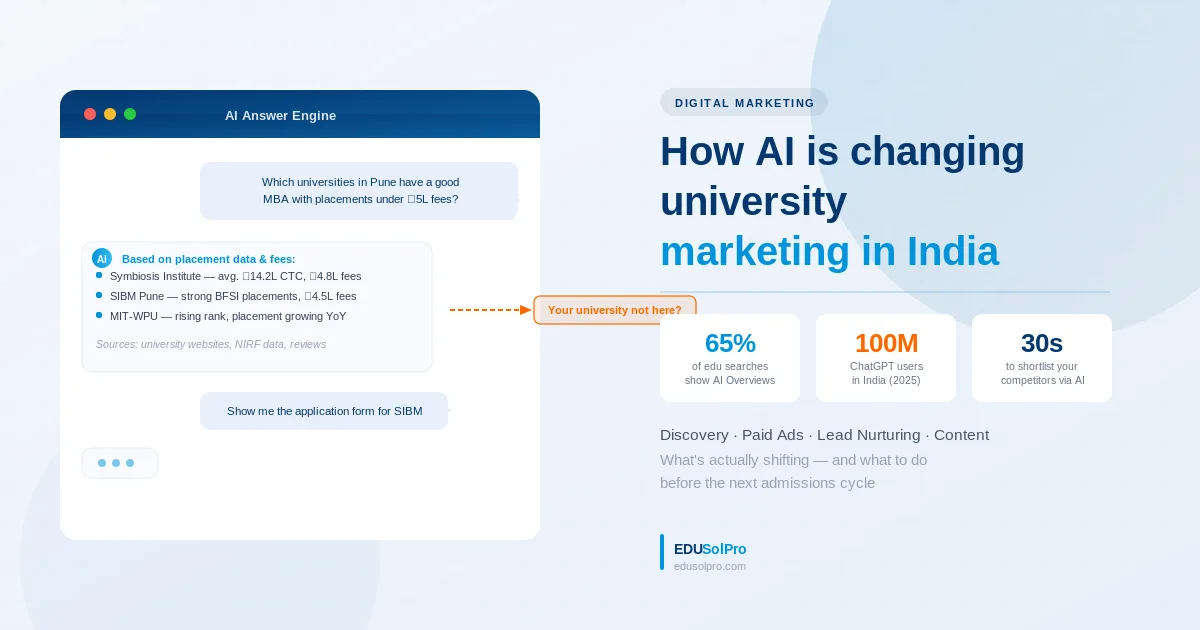
A student in Surat opens ChatGPT and types: “Which universities in Gujarat offer good BBA programmes with strong placements?”
ChatGPT responds with four universities. It names their programmes, mentions placements, notes NAAC grades. The student screenshots the answer and sends it to their parents. That shortlist is done.
Your university either appeared in that response, or it didn’t. No amount of Google Ads spend changes that. No SEO work done for a traditional search engine touches it. The student never searched Google at all.
This is the recruitment problem that Generative Engine Optimization (GEO) addresses — and most Indian universities haven’t started thinking about it yet.
What GEO Actually Means (Without the Jargon)
GEO stands for Generative Engine Optimization. It’s the practice of structuring your institution’s online presence so that AI tools — ChatGPT, Google Gemini, Perplexity, Claude, Microsoft Copilot — can find your content, understand it accurately, and include your university in the answers they generate for student queries.
It is not the same as SEO, though SEO is part of the foundation. Traditional SEO got your website onto the first page of Google results. GEO gets your university inside the answer itself — before a student decides which website to visit, sometimes before they visit any website at all.
It is also distinct from Answer Engine Optimisation (AEO), which is the technical implementation layer. AEO covers the specific tactics — FAQ schema, structured content, entity markup. GEO is the broader strategic question: why are AI systems the new discovery channel for students, and how does your entire digital presence need to shift to account for that?
How the Student Discovery Journey Has Changed
Three years ago, the typical prospective student’s path looked like this: Google search → review platforms → university website → inquiry form. Your SEO, your Google Ads, your Shiksha and Collegedunia presence all served this linear journey.
That journey still exists. But a new one has emerged alongside it, and it’s growing fastest in exactly the demographic you’re recruiting — 17 to 22-year-olds who have grown up with AI tools and use them the way older generations used Google.
The new journey looks like this: AI chatbot query → university shortlist → Google search to verify → website visit → inquiry. The AI step now happens before Google in many cases. The student uses ChatGPT or Perplexity to generate their initial shortlist, then uses Google to validate specific claims. If your university doesn’t appear in step one, you may never recover the lead.
What makes this especially significant for Indian university admissions is the nature of the decision. Choosing a university is a high-stakes, high-effort research task. Students and parents spend weeks gathering information. AI tools are well-suited to that kind of research — they synthesize across multiple sources, compare options, and answer follow-up questions conversationally. For exactly this kind of decision, AI chatbots have replaced early-stage Google searching for a large and growing segment of your prospective students.
Why Indian Universities Are Particularly Exposed
Indian universities face a specific GEO challenge that institutions in the US or UK don’t face to the same degree.
First, most Indian universities have thin, unstructured online content. Press releases, event pages, PDF notices — content that humans can parse but AI systems struggle to extract meaningful signals from. AI tools favor content that is clearly structured, directly answers questions, and is attributed to a credible, verifiable source. Most Indian university websites fail all three tests.
Second, AI systems assign credibility based on how widely an institution is referenced across authoritative sources — Wikipedia, national newspapers, UGC records, research databases, verified review platforms. Many Indian universities have little presence in these sources despite decades of operation and thousands of alumni. AI tools simply don’t have enough signal to confidently cite them.
Third, the programmes AI tools get asked about most — BBA, MBA, B.Tech, B.Pharm, law, architecture — are highly competitive. The AI isn’t going to mention every university offering the programme. It selects the ones it has clear, credible, specific information about. If your programme details, placement outcomes, and accreditation status aren’t unambiguously available in structured form, you won’t be selected.
The 5 Factors That Determine If Your University Appears in AI Answers
1. Structured content that mirrors how students ask questions
AI systems parse content that is organized around questions and direct answers. If your MBA programme page is built around what the university wants to say — heritage, faculty credentials, infrastructure — rather than what students ask — fees, placements, admission process, hostel availability — it won’t surface well in AI responses. Every programme page and blog post should be built around the questions students actually type into AI tools.
2. Citations in authoritative sources
Wikipedia is the single highest-weighted source in LLM training data. If your university doesn’t have a Wikipedia page, or has one with outdated or missing information, you have a GEO problem at the foundation level. After Wikipedia: presence in The Hindu, Times of India, LiveMint, Wire, UGC and NAAC official records, and peer-reviewed citations from your faculty. These are the sources AI systems treat as authoritative when building their knowledge of Indian higher education.
3. Entity clarity
AI systems work with entities — named things they can identify clearly. Your university is an entity. Your programmes are entities. Placements are entities. For AI to cite you confidently, it needs to recognize your institution as a distinct, clearly defined entity with consistent information across sources. Inconsistent naming (abbreviated vs. full name, different addresses, conflicting accreditation data across pages) reduces the AI’s confidence in citing you. Schema markup — specifically Organization and EducationalOrganization schema — directly addresses this.
4. Fresh, specific, dateable content
AI tools favour content published recently and containing specific, verifiable facts: placement percentages with years, named companies, NAAC grades with cycle dates, specific batch sizes. Vague claims like “excellent placements” and “industry-ready curriculum” provide no signal. “86% of the 2024 batch was placed within 90 days, with recruiters including Infosys, HDFC Bank, and Deloitte” is the kind of specific, dateable fact that AI systems can extract and cite.
5. FAQ-structured content with schema markup
AI chatbots are trained to answer questions. Content formatted as clear question-and-answer blocks — especially with JSON-LD FAQPage schema — is significantly easier for AI systems to extract and use. Every programme page and key blog post should end with 4–6 FAQs that address the specific questions students ask AI tools. Not generic questions, but the actual queries: “What is the fee structure for BBA at [university]?”, “What is the average placement package for MBA graduates?”, “Is [university] approved by NAAC/UGC?”
Three Things You Can Check Right Now
You don’t need to rebuild your entire digital presence to start. These three checks take an afternoon and immediately clarify where you stand.
Check 1: Ask ChatGPT about your own university. Open ChatGPT and type the query your target students would ask — something like “Best universities for B.Tech in [your state]” or “Which private universities in [city] have strong MBA placements?” Does your university appear? If not, what does appear — and why might those institutions have better GEO signal than yours?
Check 2: Check your Wikipedia page. Search Wikipedia for your university name. Does a page exist? Is the information accurate and current? Does it include your NAAC grade, establishment date, programmes offered, and notable alumni? A missing or thin Wikipedia page is the single highest-leverage fix in GEO because it affects both AI training data and Google Knowledge Panel accuracy simultaneously.
Check 3: Read your programme pages like an AI would. Open your most important programme page — your flagship MBA, B.Tech, or BBA. Can you find clear answers to these five questions within two minutes: fees, duration, intake size, placement rate, and admission criteria? If a human can’t find them quickly, an AI system can’t extract them reliably.
What GEO Looks Like at Scale
Individual fixes — improving a Wikipedia page, adding FAQ schema to programme pages, restructuring content around student questions — are the right starting point. But systematic GEO for a university goes deeper.
It involves auditing every programme page for entity completeness and structured data coverage. It involves a sustained content strategy that builds topical authority across the questions your students actually ask AI tools. It involves monitoring AI responses for your institution and competitors regularly — because AI citation patterns shift as training data is updated and models improve. And it involves building citations in the authoritative external sources that LLMs weight most heavily.
This is not a one-time project. AI models update. New platforms emerge. The specific content that gets cited in ChatGPT versus Perplexity versus Google AI Overviews differs. Managing this systematically is a continuous process.
For the tactical implementation layer — FAQ schema, AEO content structure, and Google AI Overviews optimization — read our detailed guide on Answer Engine Optimisation for Universities.
If you want to understand how your university currently appears in AI answers and what’s missing, our AI Search Optimisation service starts with exactly that audit.
Frequently Asked Questions
What is the difference between GEO and SEO for universities? SEO optimises your website to rank in traditional Google search results. GEO optimises your entire digital presence — website, Wikipedia, citations, structured data, content — so AI tools like ChatGPT and Perplexity include your university in the answers they generate for student queries. SEO and GEO share some foundations but serve different discovery channels.
Which AI tools should Indian universities focus on for GEO? ChatGPT (GPT-4 and above) and Perplexity are currently the most used by Indian students for education research. Google AI Overviews is important because it appears directly in Google search results. Gemini is growing. The underlying content and citation strategies that improve your visibility on one platform generally improve visibility across all of them.
Does GEO replace SEO for university marketing? No. Google search still drives the majority of university website traffic in India. SEO remains essential. GEO is an additional layer that addresses a growing segment of early-stage student discovery that traditional SEO doesn’t reach. The two complement each other — strong SEO builds the foundation that GEO builds on.
How long does it take to see GEO results? Meaningful changes in how AI tools cite your institution typically become visible within one to three months of structured improvements. Wikipedia changes can take 4–8 weeks to propagate into AI training. Content changes indexed by Google appear in AI Overviews faster — sometimes within days. Unlike SEO, there’s no single ranking metric to track; the measure of success is whether your university appears in relevant AI responses for your target programmes and location.
What is the first GEO fix a university should make? For most Indian universities, the highest-leverage first step is auditing and improving the Wikipedia page. It affects AI training data, Google Knowledge Panel accuracy, and NIRF perception signals simultaneously. After that: adding FAQ schema to programme pages and restructuring content to answer specific student questions directly.